How to Choose the Best Vehicle Tracker: A Complete Guide for Businesses and Installers
Discover how to choose the best vehicle tracker for cars, motorcycles, trucks, and fleets. Learn about the main technical criteria, functionalities, and technologies that should be evaluated before purchasing.
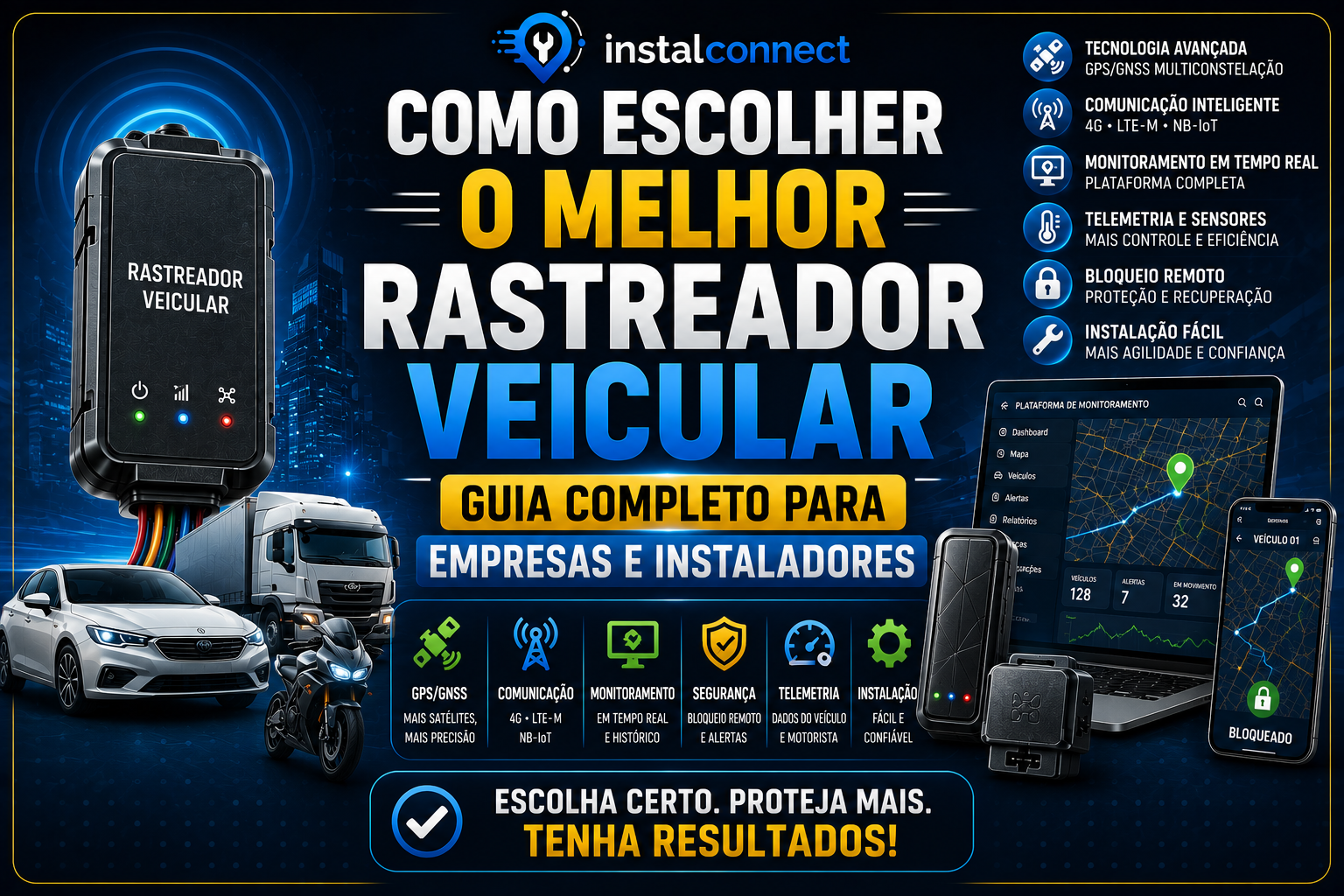
The vehicle tracking market has evolved significantly in recent years. Currently, there are hundreds of tracker models, each with different characteristics, technologies, and applications.
Choosing equipment based solely on price can result in installation difficulties, limited functionalities, and high maintenance costs over time.
In this guide, you will learn the main criteria for selecting a vehicle tracker according to the type of vehicle, application, and operational needs.
What is a Vehicle Tracker?
A vehicle tracker is an electronic device capable of determining a vehicle's location using global navigation satellite systems (GNSS) and transmitting this information to a monitoring platform using mobile communication networks.
In addition to location, many models offer additional features such as:
remote immobilizer; telemetry; sensors; real-time alerts; route history; geofences; ignition control. Before choosing, define the objective
The first question should be:
What will the tracker be used for?
Needs vary according to the application.
Examples:
protection against theft; fleet monitoring; logistics; operational control; driver management; telemetry; vehicle recovery.
Defining the objective makes equipment selection easier.
Compatibility with vehicle type
Not all trackers serve all types of vehicles.
Check if the equipment is suitable for:
cars; motorcycles; trucks; buses; agricultural machinery; construction machinery; boats (where applicable).
It is also important to consider hybrid and electric vehicles, which have specific installation characteristics.
GNSS: the more systems, the better
Currently, the best equipment works with multiple satellite constellations.
In addition to GPS, many models use:
GLONASS; Galileo; BeiDou.
This combination increases satellite availability and improves location accuracy.
Communication technology
Evaluate which communication technologies are supported.
Among them:
GSM; 4G LTE; LTE-M; NB-IoT.
The choice depends on the available infrastructure and operational needs.
Monitoring platform
The tracker is just one part of the solution.
The platform should also offer important features, such as:
real-time location; position history; alerts; reports; geofences; user management; mobile application.
An intuitive platform significantly improves the user experience.
Remote updates
Modern equipment allows for remote firmware updates.
This facilitates:
bug fixes; performance improvements; addition of new functionalities. Inputs and outputs
Check how many inputs and outputs the equipment offers.
These features allow integration of:
door sensors; temperature sensors; panic buttons; relays; ignition; additional accessories.
The greater the flexibility, the greater the number of possible applications.
Power consumption
Modern equipment has low power consumption.
Even so, it is important to check:
operating current; idling consumption; intelligent power management.
These factors directly influence the vehicle's battery life.
Ease of installation
A good tracker should facilitate the installer's work.
Observe:
reduced size; well-identified wiring harness; technical documentation; manufacturer support; ease of configuration.
These details reduce installation time.
Technical support
Excellent equipment loses value when there is no adequate support.
Before purchasing, check:
documentation; training; updates; service channels; availability of parts. Certifications and approvals
Check if the equipment meets the legal and regulatory requirements of the country where it will be used.
Certifications and approvals demonstrate compliance with technical standards and can be an important differential for companies and customers.
Scalability
If the company plans to grow, choose a solution that allows expansion.
Check if the platform supports:
multiple users; large fleets; API integrations; new sensors; advanced telemetry. Common mistakes
Among the mistakes found are:
purchasing only for the lowest price; ignoring the platform; disregarding operator coverage; choosing incompatible equipment for the application; not evaluating technical support; not checking electrical consumption. Tracker selection checklist
Before purchasing, confirm:
✔ Vehicle compatibility.
✔ GNSS technology.
✔ Communication technology.
✔ Complete platform.
✔ Sufficient inputs and outputs.
✔ Low consumption.
✔ Ease of installation.
✔ Available technical support.
✔ Certifications.
✔ Expansion capability.
Benefits of choosing correctly
A well-planned choice provides:
higher reliability; lower maintenance rate; better user experience; longer equipment lifespan; ease of expansion; reduced operational cost. Conclusion
Choosing a vehicle tracker goes far beyond comparing prices. It is necessary to evaluate the type of application, the embedded technologies, the monitoring platform, the ease of installation, and the support offered by the manufacturer.
By considering these factors, businesses and installers can select more efficient solutions, reduce operational problems, and offer higher quality service to their customers. In an increasingly competitive market, investing in appropriate technology is a decision that generates short- and long-term benefits.
Frequently Asked Questions (FAQ)
Does every tracker have a remote immobilizer?
No. Some models offer only tracking and telemetry, while others include the immobilization function.
Is it worth choosing equipment with multi-constellation GNSS?
Yes. The combined use of GPS, GLONASS, Galileo, and BeiDou increases satellite availability and improves accuracy.
Is LTE-M better than GSM?
It depends on the application. LTE-M was developed for IoT devices and usually offers advantages in terms of power consumption and mobility.
Does a tracker work for any vehicle?
Not always. It is important to check compatibility with cars, motorcycles, trucks, machinery, and electric vehicles.
Does the platform influence the choice?
Yes. Many functionalities depend directly on the monitoring platform used.