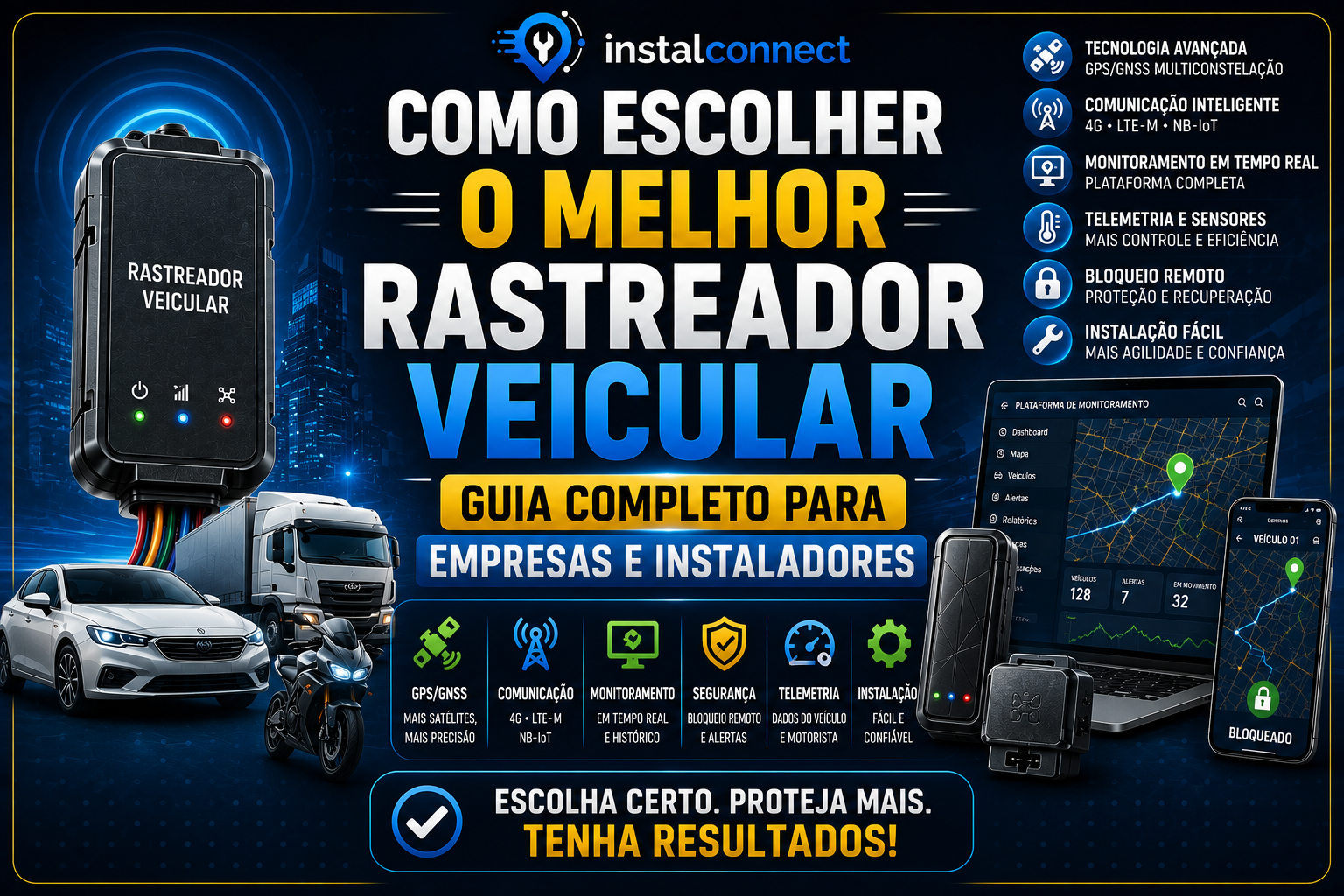
How to Choose a Professional Vehicle Tracker: The Complete Guide for Installers & Businesses
Choosing a vehicle tracker goes far beyond price. Learn about the key technical criteria, embedded technologies, certifications, and features that differentiate professional equipment from low-quality models.
The vehicle tracking market grows year after year, driven by increased demand for security, stolen vehicle recovery, fleet management, and operational cost reduction. With this expansion, the supply of equipment from different manufacturers, prices, and quality levels has also increased.
At first glance, many trackers seem to offer the exact same functions: real-time location, remote immobilization, and communication with a monitoring platform. However, behind these basic features are technical differences that directly impact reliability, location accuracy, communication stability, and equipment durability.
Choosing a tracker based solely on the lowest price can lead to high maintenance rates, communication loss, failures in vehicle recovery, and losses for businesses and customers.
In this guide, you will learn about the main aspects that should be analyzed before purchasing a professional tracker.
What truly defines a professional tracker?
A professional tracker is designed to operate continuously in harsh environments, withstanding vibrations, temperature variations, electrical interference, and long periods of operation without compromising its stability.
Much more than a simple location device, it is an embedded electronic device that brings together several systems working simultaneously.
Among them:
- GNSS receiver;
- Cellular modem;
- Processor;
- Internal memory;
- Power management;
- Embedded firmware;
- Digital inputs and outputs;
- Backup battery.
The quality of each of these components directly influences the equipment's final performance.
The importance of the GNSS chipset
The heart of any tracker is its GNSS receiver.
Although many people use the term GPS to refer to satellite location, the most modern equipment currently works with multiple constellations.
Among them:
- GPS (United States);
- GLONASS (Russia);
- Galileo (European Union);
- BeiDou (China);
- QZSS (Japan, in some models).
The greater the number of satellites available to the equipment, the greater the location accuracy tends to be, especially in urban areas with tall buildings, tunnels, or areas with difficult reception.
Receiver sensitivity
It's not enough just to state that the equipment has GPS.
A good tracker offers high reception sensitivity.
This allows it to maintain a signal even in partially enclosed spaces, underground parking lots, or areas with natural obstacles.
More sensitive receivers can also achieve the first fix in less time, reducing the so-called TTFF (Time To First Fix).
Cellular communication makes all the difference
After obtaining the location, the tracker needs to transmit this information to the platform.
That's where the cellular modem comes in.
Today there is equipment compatible with:
- 2G;
- 3G;
- 4G LTE;
- LTE Cat M1;
- NB-IoT.
Although many devices still operate on 2G networks, the global trend is the gradual replacement of this technology.
Equipment compatible with more modern networks offers greater stability, lower latency, and greater future availability.
The role of the M2M chip
Another important factor is the quality of the chip used.
M2M (Machine to Machine) chips are developed specifically for telemetry and tracking equipment.
Their advantages include:
- Greater stability;
- National roaming;
- Remote management;
- Specific plans for IoT;
- Greater network availability.
Using conventional chips in professional applications can compromise system operation.
Internal battery is essential
A professional tracker must continue to function even when the main power is disconnected.
For this, it uses a rechargeable internal battery.
It allows for:
- Sending power cut alerts;
- Location after attempted sabotage;
- Temporary continuity of operation.
Autonomy varies according to the manufacturer and usage profile.
Intelligent power management
Modern equipment has algorithms capable of drastically reducing consumption when the vehicle remains off.
This prevents the automotive battery from discharging during long periods of non-use.
In addition, some models constantly monitor battery voltage and send preventive alerts.
Digital inputs and outputs
The greater the integration capacity of the equipment, the greater its flexibility.
A professional tracker normally offers inputs for:
- Ignition;
- Panic button;
- Sensors;
- Doors;
- Temperature;
- Accessories.
In addition to outputs for:
- Immobilization;
- Siren;
- Horns;
- Actuators;
- External relays.
Firmware makes a difference
Many companies only analyze the hardware.
However, the firmware is equally important.
It is responsible for:
- Communication;
- Security;
- Battery management;
- Remote updates;
- Protocols;
- Stability.
Serious manufacturers provide frequent updates for bug fixes and inclusion of new features.
OTA update
OTA stands for Over The Air.
This technology allows firmware to be updated remotely, without the need to remove the equipment from the vehicle.
In addition to reducing maintenance costs, it significantly improves system security.
Resistance to automotive conditions
The automotive environment is extremely aggressive for electronic equipment.
A good tracker must withstand:
- Constant vibration;
- Dust;
- Humidity;
- Voltage variations;
- High temperatures.
Robust casings and quality electronic components significantly increase its lifespan.
ANATEL certification
In Brazil, equipment that uses radiofrequency needs to be certified by ANATEL.
This certification ensures that the equipment meets the technical requirements established for operation in the country.
Before purchasing any tracker, verify that the model has current certification.
In addition to legal compliance, this reduces risks related to compatibility with national mobile networks.
Platform also matters
The best equipment on the market loses value if connected to an unstable platform.
A good platform should offer:
- Real-time monitoring;
- Position history;
- Geofences;
- Configurable alerts;
- Remote immobilization;
- Reports;
- Android and iOS applications;
- API for integrations;
- High availability.
The tracker and the platform must work together to deliver a complete solution.
Beware of extremely cheap equipment
Equipment sold at values much lower than the average usually has important limitations, such as:
- Inferior electronic components;
- Low precision;
- Lower performance antennas;
- Limited firmware;
- Lower thermal resistance;
- Lack of technical support;
- Low availability of updates.
The lower initial cost often results in higher expenses for maintenance and replacements.
How to choose the ideal tracker?
Before purchasing, evaluate:
- ANATEL certification;
- Compatibility with current networks;
- Modern GNSS chipset;
- OTA updates;
- Internal battery;
- Rest consumption;
- Platform quality;
- Manufacturer's technical support;
- Warranty;
- Availability of parts and assistance.
More important than comparing prices is analyzing the total cost of operation over the equipment's lifespan.
Conclusion
Choosing a professional vehicle tracker requires a much broader technical analysis than simply verifying the presence of GPS or remote immobilization.
GNSS chipset, cellular communication quality, firmware, power management, ANATEL certification, remote updates, and robust construction are factors that determine the equipment's real performance.
Tracking companies that invest in reliable equipment reduce technical assistance costs, increase customer satisfaction, and strengthen their reputation in the market.
For installers, knowing these criteria is a competitive advantage. For businesses and fleet managers, it means investing in a solution capable of providing security, stability, and operational continuity for many years.
Frequently Asked Questions (FAQ)
Do all trackers have the same accuracy?
No. Accuracy depends on the GNSS chipset, antenna sensitivity, the number of satellites used, and firmware quality.
Is it worth buying a very cheap tracker?
Not always. Low-cost equipment may have lower durability, less communication stability, and a greater need for maintenance.
Why is ANATEL certification important?
It ensures that the equipment meets the technical requirements to operate on Brazilian networks and complies with the legislation.
What is an OTA update?
It is the remote update of the tracker's firmware via the data network, without the need to remove the equipment from the vehicle.
What is the difference between GPS and GNSS?
GPS is one of the satellite positioning systems. GNSS is the term used for the set of different constellations, such as GPS, GLONASS, Galileo, and BeiDou, providing greater accuracy and signal availability.