LTE-M, NB-IoT, and 4G: Which Technology is Better for Vehicle Trackers?
Learn the differences between LTE-M, NB-IoT, and 4G and discover which technology offers better performance for vehicle trackers, IoT devices, and telemetry applications.
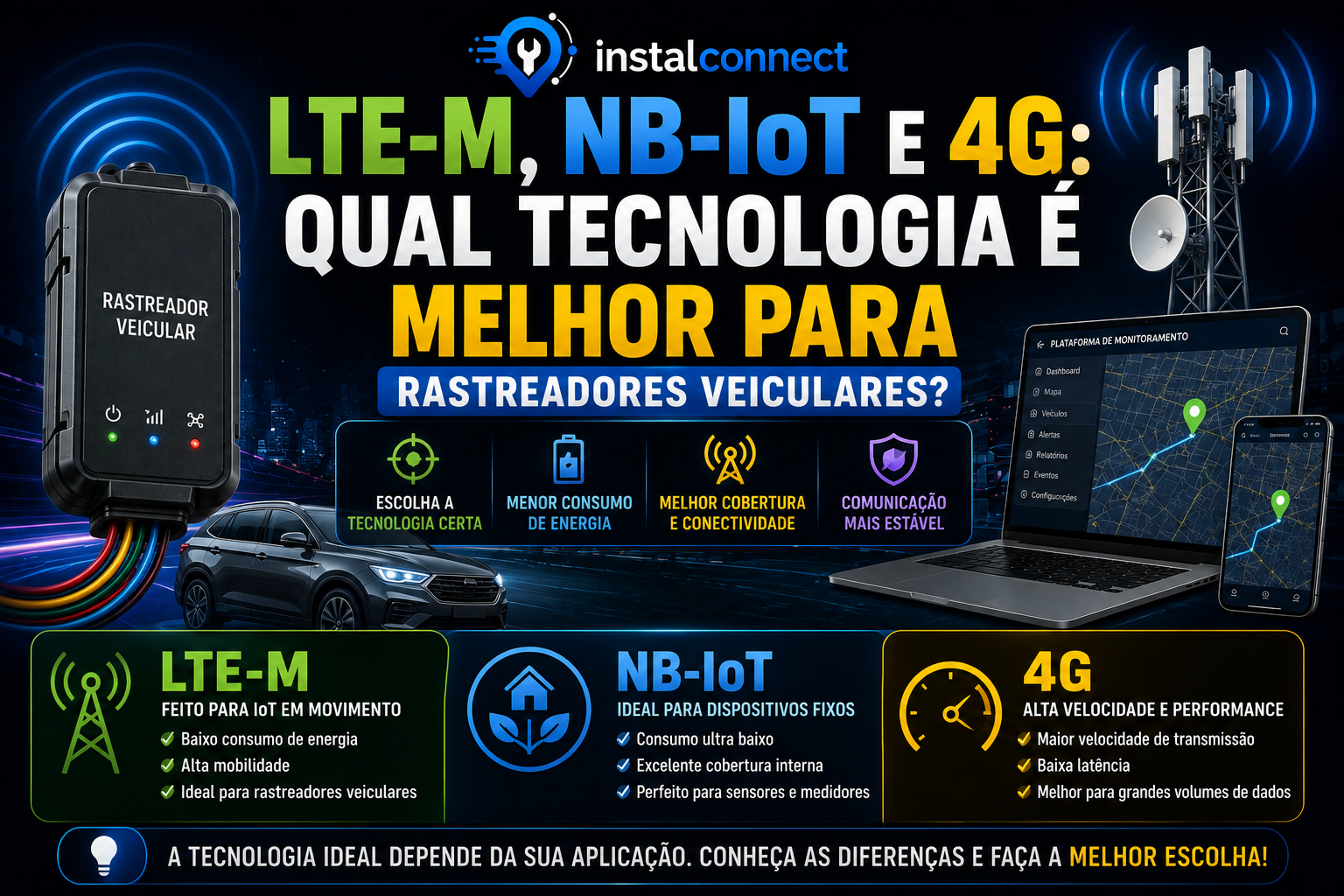
Vehicle trackers have evolved significantly in recent years. While most equipment previously relied exclusively on GSM (2G) networks, it's now common to find devices compatible with more modern technologies, such as LTE-M and NB-IoT.
These networks were developed specifically for Internet of Things (IoT) applications, offering lower power consumption, greater efficiency, and better performance for continuously connected devices.
But which one is best suited for a vehicle tracker?
In this article, you will learn about the characteristics of each technology and understand in which situations they offer advantages.
The Evolution of Mobile Networks
The communication used by trackers has followed the evolution of cellular networks.
The sequence was:
- 2G (GSM)
- 3G
- 4G (LTE)
- LTE-M
- NB-IoT
Each new generation brought important improvements in speed, stability, energy efficiency, and connection capacity.
What is 4G (LTE)?
4G LTE was developed to provide high-speed data transmission.
It is ideal for applications that require:
- large data volumes;
- low latency;
- navigation;
- videos;
- mobile applications.
Although also used in some trackers, its primary purpose was not specifically designed for IoT devices.
What is LTE-M?
LTE-M stands for LTE for Machines.
It was created especially for connected equipment that transmits small amounts of data continuously.
Its main characteristics include:
- lower power consumption;
- good mobility;
- excellent coverage;
- efficient communication for embedded devices;
- support for high-speed movement.
These characteristics make LTE-M very suitable for vehicle tracking.
What is NB-IoT?
NB-IoT stands for Narrowband Internet of Things.
It is a technology aimed at sensors and devices that send small amounts of data infrequently.
Its advantages include:
- extremely reduced consumption;
- excellent coverage in enclosed environments;
- large capacity for thousands of devices.
On the other hand, its lower transmission rate may not be the best choice for applications requiring frequent location updates for vehicles in motion.
Which Technology is Better for Trackers?
It depends on the application.
Generally:
LTE-M
Is suitable for:
- vehicle trackers;
- telemetry;
- logistics;
- fleet management;
- mobile devices.
NB-IoT
Is better suited for:
- smart meters;
- environmental sensors;
- public lighting;
- fixed monitoring;
- smart agriculture.
4G
Continues to be an excellent alternative for equipment that requires greater bandwidth and applications with intense data transmission.
Power Consumption
Among the compared technologies:
- LTE-M offers low consumption;
- NB-IoT has even lower consumption;
- Traditional 4G typically requires higher energy consumption.
This factor directly influences the battery life of battery-powered devices.
Network Coverage
LTE-M and NB-IoT technologies were designed to improve coverage in places where conventional signals experience difficulties.
This includes:
- underground parking lots;
- warehouses;
- industrial areas;
- dense urban regions.
Even so, availability depends on the infrastructure offered by the operator in each region.
Mobility
This is one of the main differentiators.
LTE-M was developed for moving equipment.
It supports rapid changes between network cells, making it ideal for vehicles.
NB-IoT, on the other hand, was primarily designed for stationary devices or those with low mobility.
Security
All three technologies use modern authentication and encryption features.
However, LTE-M and NB-IoT were developed considering specific Internet of Things requirements, allowing for greater efficiency in remote device management.
How to Choose the Best Technology?
Before purchasing a tracker, consider:
- type of application;
- frequency of updates;
- available coverage;
- technology supported by the operator;
- equipment compatibility;
- communication cost.
There is no single answer.
Each project has specific needs.
Most Common Errors
Among the most frequent misconceptions are:
- believing that speed is the only important factor;
- using inadequate technologies for IoT devices;
- ignoring operator coverage;
- not checking equipment compatibility;
- confusing LTE-M with conventional 4G.
Checklist for Choosing the Technology
Before deployment, confirm:
✔ Available coverage.
✔ Tracker compatibility.
✔ Desired transmission frequency.
✔ Type of application.
✔ Energy consumption.
✔ Compatible data plan.
✔ Remote management available.
✔ Operator support.
Benefits of the Correct Choice
Selecting the appropriate technology provides:
- greater stability;
- lower energy consumption;
- better coverage;
- more efficient communication;
- reduction of failures;
- longer equipment lifespan.
Conclusion
LTE-M, NB-IoT, and 4G technologies address different needs within the world of connectivity. While 4G was developed for high-speed applications, LTE-M and NB-IoT emerged to meet the specific demands of the Internet of Things.
For vehicle trackers, LTE-M usually offers an excellent balance between mobility, coverage, energy efficiency, and reliability. NB-IoT, on the other hand, stands out in fixed devices and low-data-demand sensors. The ideal choice always depends on the project characteristics, available infrastructure, and communication requirements.
Frequently Asked Questions (FAQ)
Does LTE-M replace 4G?
No. LTE-M uses LTE infrastructure but is optimized for IoT applications.
Is NB-IoT suitable for vehicle trackers?
It can be used in some applications, but it is more suitable for devices with low mobility and small data transmissions.
Does LTE-M consume less power than 4G?
Yes. This is one of the main advantages of the technology.
Do LTE-M and NB-IoT use a SIM chip?
Yes. Depending on the equipment, they use a SIM or eSIM chip compatible with the operator's network.
Which technology is expected to grow in the coming years?
Both LTE-M and NB-IoT are part of the global expansion of the Internet of Things and are expected to gain increasing prominence in connected applications.