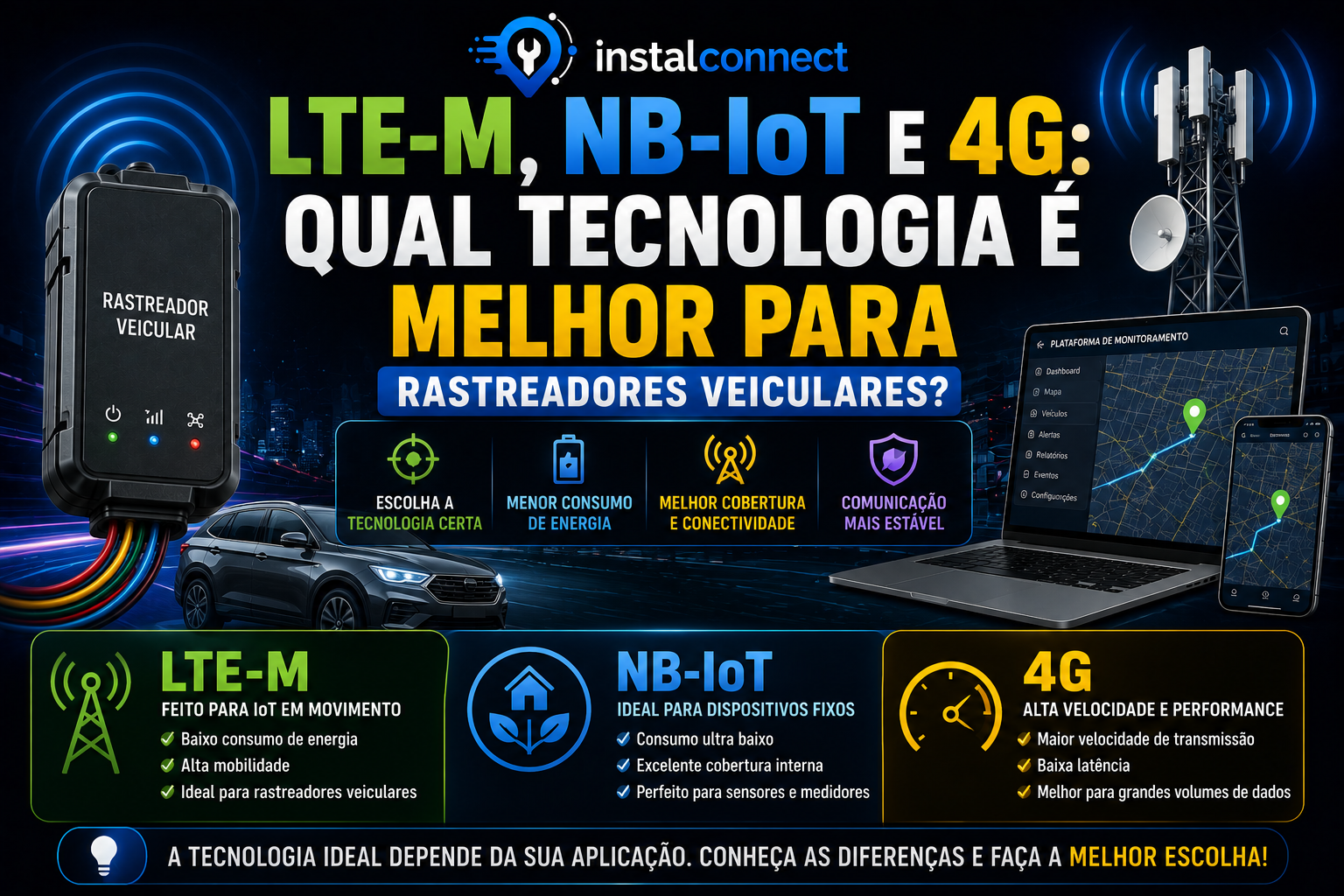
What Are M2M and IoT? Understand Why Tracker Chips Differ from Conventional Ones
Discover what M2M and IoT mean, why chips used in vehicle trackers differ from conventional ones, and the advantages of this technology for device communication.

Upon opening a vehicle tracker, it's common to find a chip very similar to those used in cell phones. This leads many to believe that any carrier's chip can be used in a tracking device.
In practice, however, most modern trackers use chips developed for M2M (Machine to Machine) or IoT (Internet of Things) applications. These technologies were created to enable automatic communication between devices, offering greater stability, security, and availability.
In this article, you will understand what M2M and IoT mean, what their differences are, and why these chips are more suitable for vehicle tracking.
What is M2M?
M2M stands for Machine to Machine.
This concept describes automatic communication between equipment, without the need for human intervention.
Instead of a person using a smartphone to access the internet, the devices themselves exchange information.
Some examples include:
- vehicle trackers;
- smart energy meters;
- industrial machines;
- remote sensors;
- agricultural equipment;
- telemetry systems.
What is IoT?
IoT stands for Internet of Things.
It is a broader concept that encompasses devices connected to the internet capable of collecting, transmitting, and sharing information.
In practice, M2M can be considered one of the technologies that are part of the IoT universe.
Today, we find IoT in various sectors:
- smart homes;
- smart cities;
- environmental monitoring;
- healthcare;
- logistics;
- industry;
- agriculture;
- vehicle security.
What is the difference between M2M and IoT?
Although they are related terms, they have different objectives.
M2M focuses on direct communication between equipment.
IoT, on the other hand, involves an entire connected ecosystem where devices send data to platforms, applications, and cloud services.
In modern trackers, both concepts work together.
Why are chips for trackers different?
M2M and IoT chips are designed to function continuously in electronic equipment.
Their characteristics include:
- high availability;
- remote management;
- greater stability;
- specific data transmission plans;
- less need for manual intervention;
- support for telemetry applications.
These features make the service more reliable than a conventional mobile phone plan.
Advantages of M2M and IoT chips
Compared to traditional chips, they offer several benefits:
- continuous communication;
- better line management;
- lower risk of blocking due to atypical usage;
- support for embedded applications;
- specific plans for low data consumption;
- higher reliability for devices connected 24/7.
How do these chips work in the tracker?
The process is simple:
- The GNSS calculates the vehicle's position.
- The tracker organizes the information.
- The M2M chip connects to the operator's network.
- Data is transmitted via the internet.
- The platform receives and displays the location.
This entire flow occurs automatically.
Do M2M chips use APN?
Yes.
Like other connected devices, many M2M chips use specific APNs to access the operator's data network.
These configurations are usually different from those used in conventional lines.
What about coverage?
Coverage still depends on the available infrastructure in the region.
However, many providers offer solutions capable of utilizing agreements between operators, increasing service availability in different locations.
This characteristic is especially important for companies that monitor fleets across the national territory.
Data transmission security
M2M and IoT services often offer additional features to enhance communication security, such as:
- device authentication;
- remote chip management;
- connectivity monitoring;
- data consumption control;
- specific policies for IoT equipment.
These features contribute to more stable and secure operations.
Where else do we find M2M and IoT?
In addition to vehicle tracking, these technologies are present in:
- agricultural machinery;
- hospital equipment;
- ATMs;
- environmental sensors;
- smart public lighting;
- water meters;
- security systems;
- fleet control;
- logistics.
The number of connected devices is expected to continue growing in the coming years.
Most common errors
Among the most frequent misconceptions are:
- believing that any chip works the same way;
- using conventional phone plans for critical applications;
- ignoring APN settings;
- not considering operator coverage;
- confusing M2M with GPS.
Checklist for choosing a tracker chip
Before contracting a service, confirm:
✔ Compatibility with the tracker.
✔ Adequate coverage for the operating region.
✔ Plan designed for M2M or IoT.
✔ APN correctly configured.
✔ Remote management available.
✔ Specialized technical support.
✔ Good communication stability.
✔ Compatibility with the platform used.
Benefits of M2M and IoT chips
When using an appropriate solution for tracking, the benefits include:
- greater communication stability;
- lower incidence of offline equipment;
- better connectivity management;
- higher reliability in data transmission;
- reduction of operational failures;
- greater availability for telemetry applications.
Conclusion
M2M and IoT chips represent an important evolution for vehicle tracking. Unlike conventional chips, they were developed to keep devices continuously connected, with greater stability, remote management, and specific plans for data transmission.
Understanding these technologies helps installers, tracking companies, and fleet managers choose more suitable solutions, reduce communication failures, and offer a more reliable service to customers. As the Internet of Things advances, the use of connected devices tends to grow, making this knowledge increasingly relevant.
Frequently Asked Questions (FAQ)
What does M2M mean?
M2M stands for Machine to Machine, or automatic communication between equipment.
What is IoT?
IoT stands for Internet of Things, a concept that connects devices to the internet to collect, share, and process information.
Can I use a regular chip in a tracker?
Some equipment can function with conventional chips, but M2M or IoT chips typically offer greater stability, remote management, and more suitable plans for tracking applications.
Do M2M chips use APN?
Yes. In many cases, they use specific APNs defined by the operator or service provider.
Does M2M depend on GPS?
No. GPS determines the vehicle's location, while M2M is responsible for transmitting information through the data network.