How to Correctly Find the Ignition-Switched Live (Ignition/ACC) Without Compromising Vehicle Electrics
Learn how to correctly identify the ignition-switched live during vehicle tracker installations. Discover the best techniques, recommended tools, and errors that can compromise vehicle electrics.
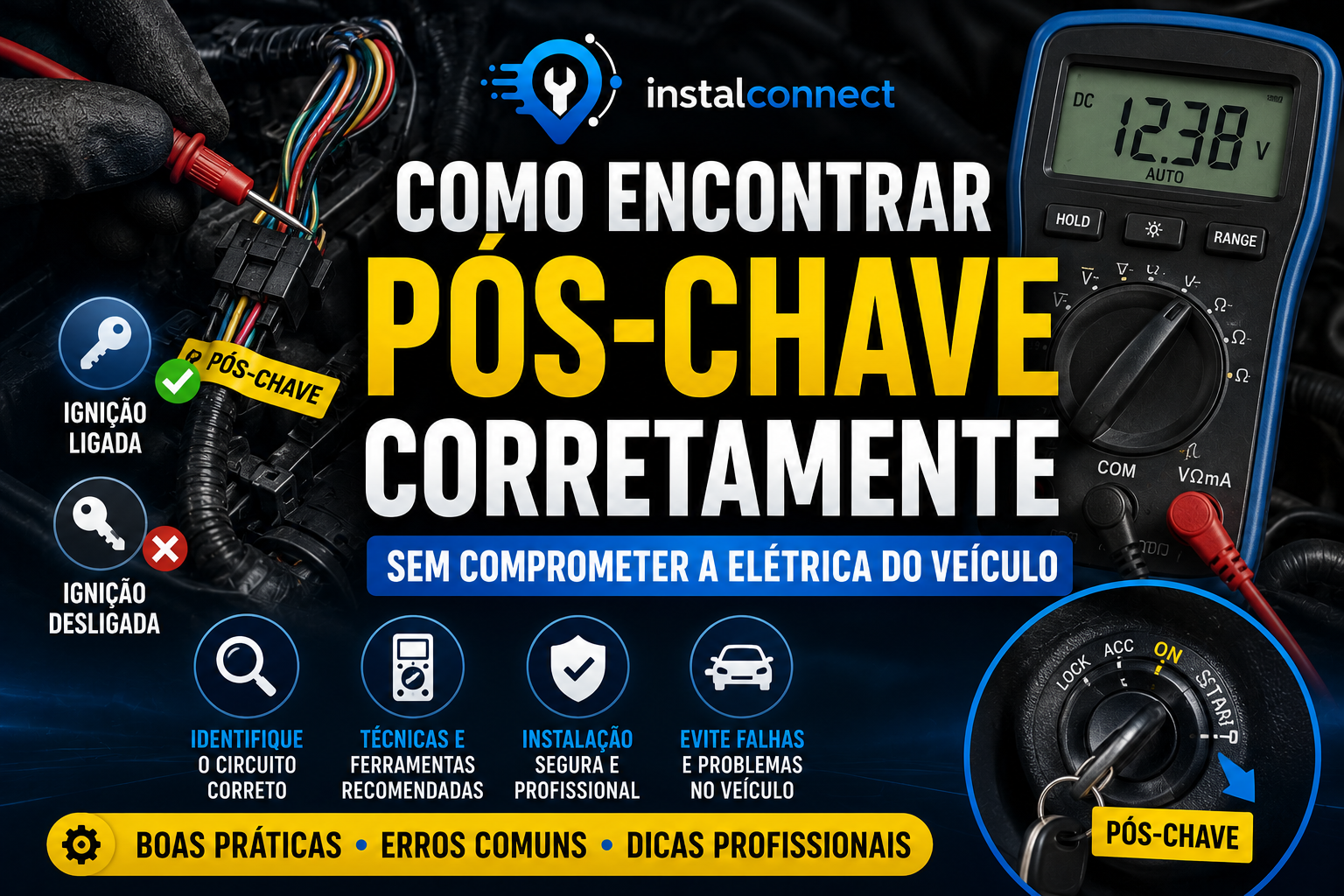
During the installation of a vehicle tracker, few points are as crucial as correctly identifying the ignition-switched live (often referred to as ignition or ACC). This power supply informs the device when the ignition has been turned on or off, allowing various functions to operate correctly, such as ignition control, programmed blocking, usage reports, and telemetry events.
While it may seem like a simple task, incorrectly locating the ignition-switched live can lead to tracker malfunctions, unnecessary battery drain, error messages on the dashboard, and even damage to the vehicle's electronic systems.
In this article, you will learn how to correctly identify the ignition-switched live, which tools to use, and which practices to avoid to ensure a safe and professional installation.
What is the ignition-switched live?
The ignition-switched live is an electrical circuit that receives power only when the vehicle's ignition is on.
When the key is turned off, this circuit stops receiving voltage.
The tracker uses this information to identify various events, such as:
- Trip start;
- Vehicle shutdown;
- Engine running time;
- Programmed blocks;
- Usage reports;
- Activation of specific functions.
Why correctly identify the ignition-switched live?
An incorrectly chosen point can lead to several problems.
Among them are:
- Tracker remaining on continuously;
- Incorrect events in the system;
- Unexpected blocks;
- Excessive auxiliary battery consumption;
- Telemetry failures;
- Loss of reliability of transmitted information.
Professional installation depends on precise identification of this circuit.
Not every wire that turns on and off is an ignition-switched live
This is a very common mistake.
Various electronic modules remain energized for a few minutes after the ignition is turned off.
Others are activated by opening doors, the presence of a smart key, or comfort systems.
Therefore, relying solely on a quick measurement can lead to incorrect diagnoses.
It is important to observe the circuit's behavior for a few minutes before concluding that it is truly an ignition-switched live.
Use a quality multimeter
Although test pens can be useful in some situations, the multimeter remains the most reliable tool for this type of diagnosis.
With it, you can check:
- Voltage;
- Continuity;
- Circuit stability;
- Power behavior before and after ignition.
Additionally, it reduces the risk of incorrect interpretations.
Always consult the wiring diagram
Whenever available, use the vehicle's technical documentation.
The wiring diagram allows precise identification of:
- Constant power supply;
- Ignition-switched live;
- Grounds;
- Fuses;
- Electronic modules;
- Communication networks.
This reduces installation time and avoids unnecessary interventions.
Pay attention to vehicles with Start/Stop buttons
In vehicles equipped with push-button start, the power supply behavior may differ from conventional models.
Depending on the button's position and the vehicle's state, some circuits remain active for specific periods.
Therefore, it is essential to understand the model's operation before installation.
Electric and hybrid vehicles
In electrified vehicles, the electrical architecture is usually even more sophisticated.
Many modules enter power-saving mode, while others remain active for certain periods.
Before performing any intervention, consult the technical documentation and follow the manufacturer's recommendations.
Avoid cutting wires unnecessarily
Whenever possible:
- Preserve the original harness;
- Use appropriate connectors;
- Make reversible connections;
- Maintain a professional finish.
These practices facilitate future maintenance and reduce risks.
Perform tests before final assembly
After locating the ignition-switched live, perform various tests.
Check:
- Ignition on;
- Ignition off;
- Door opening;
- Vehicle locking;
- Time required for modules to completely shut down.
Only then confirm the installation.
Document the point used
Recording the chosen point facilitates future maintenance.
Whenever possible:
- Photograph the installation;
- Record the circuit used;
- Identify the harness;
- Document the procedure performed.
This practice significantly reduces the time for future interventions.
Most common errors
Among the most common errors are:
- Using constant power as ignition-switched live;
- Relying only on a test pen;
- Cutting wires unnecessarily;
- Ignoring module shutdown time;
- Not performing tests after installation;
- Not consulting the wiring diagram.
Checklist for correctly identifying the ignition-switched live
Before finalizing the installation, confirm:
✔ The circuit was identified with a multimeter.
✔ Its behavior was observed for a few minutes.
✔ The circuit genuinely turns off after ignition.
✔ There are no error messages on the dashboard.
✔ The harness was preserved.
✔ Connections are protected.
✔ The point was documented.
✔ All tests have been completed.
Benefits of correct identification
Correctly performed installation provides:
- Greater tracker reliability;
- More accurate events;
- Reduced failures;
- Lower battery consumption;
- Easier maintenance;
- Longer installation lifespan.
Conclusion
Correctly finding the ignition-switched live is a fundamental step to ensure the proper functioning of a vehicle tracker. More than just locating an energized wire, it is necessary to understand the vehicle's electrical behavior, use appropriate tools, and follow technical procedures that preserve the integrity of the original system.
Professionals who adopt best practices, document their installations, and perform complete tests deliver a more reliable service, reduce rework, and strengthen their reputation in the market.
Frequently Asked Questions (FAQ)
Can I identify the ignition-switched live with just a test pen?
It can be helpful in some situations, but a multimeter offers more precise and reliable measurements.
Is every wire that turns off after removing the key an ignition-switched live?
No. Some modules remain energized for a few minutes or are activated by specific events, such as door opening or key presence.
Do vehicles with a Start/Stop button have an ignition-switched live?
Yes, but circuit behavior can vary depending on the manufacturer and vehicle model.
Can I cut the original harness to make the connection?
Whenever possible, no. Prefer methods that preserve the originality of the installation and follow the manufacturer's recommendations.
Why should I document the point used?
Documentation facilitates future maintenance, reduces diagnostic time, and helps maintain a quality standard in installations.
Related articles
 Tracking Equipment
What is APN and How to Properly Configure a Vehicle Tracker
Learn what APN is, how it works, and how to properly configure a vehicle tracker to ensure communication with the monitoring platform and avoid transmission failures.
 Tracking Equipment
How GSM Communication Works in Vehicle Trackers: Understanding How Data Reaches the Platform
Discover how GSM communication works in vehicle trackers and understand how location information is transmitted from the vehicle to the monitoring platform using mobile networks.
 Tracking Equipment
GPS vs GNSS: What's the Difference and Why Do Modern Trackers Use Multiple Satellite Systems?
Understand the difference between GPS and GNSS and discover why modern trackers use multiple global navigation satellite systems for greater accuracy, availability, and reliability.