
How GPS Works in Vehicle Trackers: Understanding the Technology Behind Location
Discover how GPS works in vehicle trackers, how satellites determine a vehicle's position, and what factors influence location accuracy.
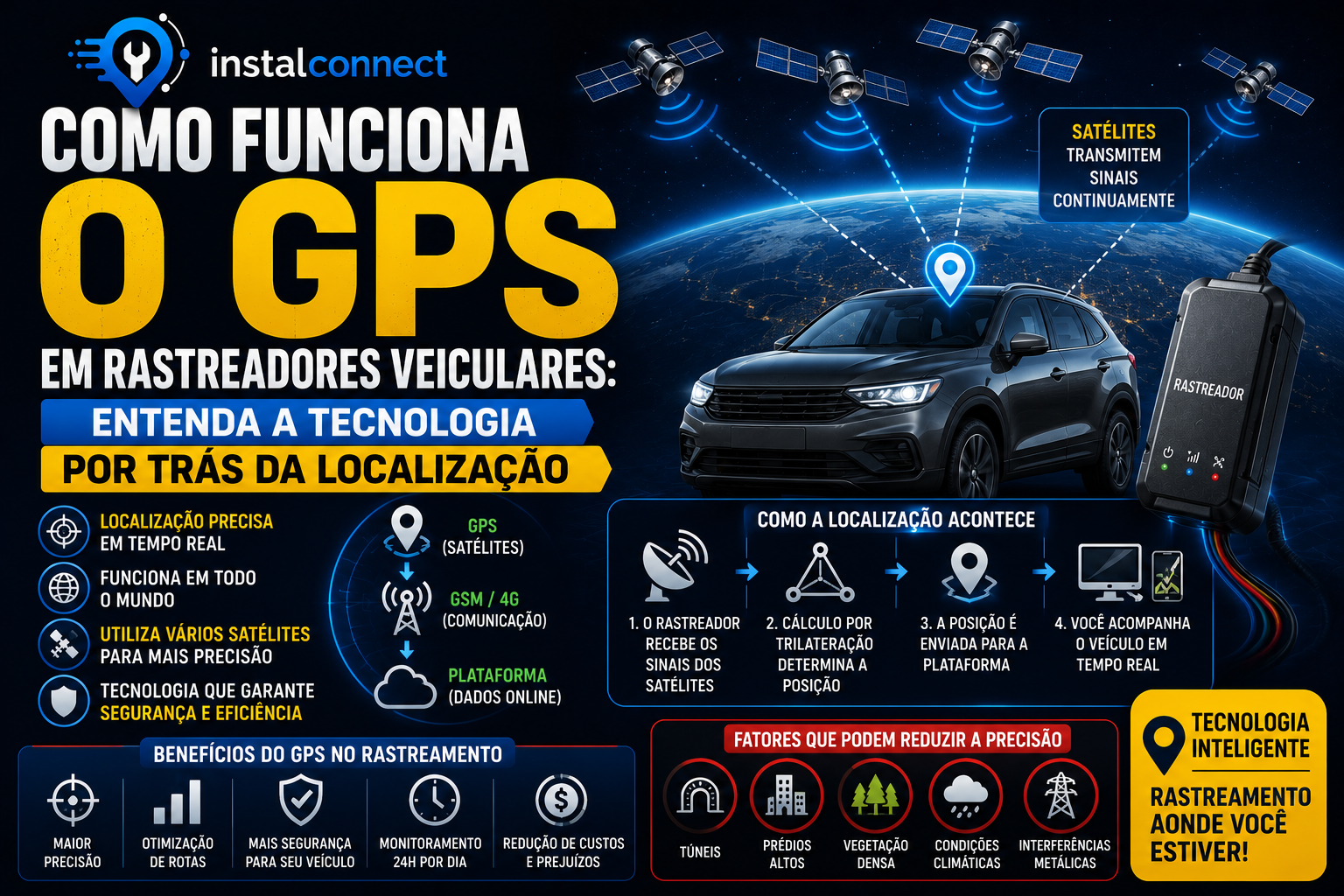
When we see a vehicle being located in real-time by a tracking platform, it's easy to imagine that everything happens simply. However, behind this technology lies a complex set of systems that work together to calculate the vehicle's position with great precision.
GPS revolutionized navigation and made vehicle tracking possible almost anywhere on the planet. Logistics companies, trucking companies, vehicle protection associations, rental agencies, and thousands of users daily use this technology to monitor movements, increase security, and optimize operations.
In this article, you will understand how GPS works, how a tracker determines its position, and what factors can influence location accuracy.
What is GPS?
GPS stands for Global Positioning System, a global satellite-based positioning system.
Originally developed for military purposes, today it is widely used in civilian applications such as:
- navigation;
- vehicle tracking;
- precision agriculture;
- aviation;
- maritime transport;
- smartphones;
- logistics.
Its main objective is to determine the geographical position of a receiver anywhere where there is sufficient visibility to the satellites.
How do satellites help locate a vehicle?
Contrary to what many people imagine, GPS does not send signals to satellites.
The process happens in reverse.
Satellites continuously transmit information containing:
- orbital position;
- extremely precise time;
- satellite identification.
The GPS receiver installed in the tracker only receives these signals and performs calculations to determine its location.
The principle of trilateration
To determine its position, the tracker measures the time it takes for the signal to arrive from different satellites.
Since the signal propagation speed is known, it is possible to calculate the approximate distance to each satellite.
With these distances, the equipment performs a mathematical process called trilateration, determining its position on the Earth's surface.
The greater the number of available satellites, the greater the accuracy of the location tends to be.
How many satellites are needed?
Although three satellites allow a basic position estimate, the receiver typically uses four or more satellites to calculate:
- latitude;
- longitude;
- altitude;
- internal clock correction.
Modern trackers commonly use signals from several global navigation systems simultaneously, increasing availability and accuracy.
GPS does not depend on the internet
This is a very common question.
GPS works without an internet connection.
The receiver directly receives signals transmitted by satellites.
The internet or cellular network is only used afterward to send these coordinates to the monitoring platform.
So why is there a cell chip in the tracker?
GPS only tells you where the vehicle is.
For this information to reach the monitoring center, the tracker uses a cellular communication module (GSM, 3G, 4G, LTE-M, or other compatible technologies).
In other words:
- GPS determines the position;
- the cellular network transmits this information.
They are different technologies that work together.
What can reduce GPS accuracy?
Several factors can interfere with location quality.
Among them:
- tunnels;
- underground garages;
- very tall buildings;
- metal structures;
- extremely dense vegetation;
- specific signal reception conditions.
In most situations, the system quickly regains accuracy once it has good visibility to the satellites again.
Does antenna positioning make a difference?
Yes.
The location where the GPS antenna is installed directly influences the quality of reception.
Good practices include:
- avoiding metal plates over the antenna;
- keeping distance from sources of electromagnetic interference;
- respecting manufacturer's guidelines;
- testing signal quality before final assembly.
GPS and electric vehicles
In electric and hybrid vehicles, GPS operation remains essentially the same.
The main concern remains the correct antenna installation and adequate power supply for the tracker.
The characteristics of the positioning system do not change based on the type of motorization.
Is GPS the only navigation system?
No.
In addition to GPS, there are other global navigation satellite systems (GNSS), such as:
- GLONASS (Russia);
- Galileo (European Union);
- BeiDou (China).
Many modern trackers can use signals from several of these systems simultaneously, increasing location availability and accuracy.
Most common errors
Among the problems encountered are:
- antenna installed under metal structures;
- poorly seated connectors;
- damaged cables;
- installation near interference sources;
- confusing GPS failure with GSM communication failure.
Checklist for best GPS performance
Before finalizing the installation, confirm:
✔ Antenna correctly positioned.
✔ Cables protected.
✔ Connectors firm.
✔ Good satellite reception.
✔ Test performed in an open area.
✔ Communication with the platform working.
✔ Installation documented.
✔ Equipment correctly configured.
Benefits of understanding how GPS works
Understanding this technology allows for:
- faster diagnostics;
- better antenna positioning;
- reduced failures;
- greater location accuracy;
- more professional installations;
- increased customer confidence.
Conclusion
GPS is one of the technologies that made modern vehicle tracking possible. Although its operation involves complex calculations and communication with orbiting satellites, its basic principle is simple: the receiver measures signals sent by satellites to calculate its position accurately.
For the installer, understanding this process is essential. Good antenna positioning, careful installation, and understanding the difference between satellite-based location and data transmission help reduce failures, improve system performance, and deliver more reliable service to the customer.
Frequently Asked Questions (FAQ)
Does GPS work without internet?
Yes. GPS receives signals directly from satellites. The internet or cellular network is only used to transmit the location to the platform.
Does GPS send signals to satellites?
No. Satellites continuously transmit signals, and the receiver only receives them to calculate its position.
How many satellites does a tracker use?
Typically four or more, although modern equipment can use signals from various GNSS systems simultaneously.
Does antenna positioning influence accuracy?
Yes. Inadequate installation can significantly reduce the quality of signal reception.
Are GPS and GSM the same thing?
No. GPS determines the vehicle's position, while GSM (or other cellular technologies) sends that information to the monitoring platform.
Related articles
 Tracking Equipment
What is APN and How to Properly Configure a Vehicle Tracker
Learn what APN is, how it works, and how to properly configure a vehicle tracker to ensure communication with the monitoring platform and avoid transmission failures.
 Tracking Equipment
How GSM Communication Works in Vehicle Trackers: Understanding How Data Reaches the Platform
Discover how GSM communication works in vehicle trackers and understand how location information is transmitted from the vehicle to the monitoring platform using mobile networks.
 Tracking Equipment
GPS vs GNSS: What's the Difference and Why Do Modern Trackers Use Multiple Satellite Systems?
Understand the difference between GPS and GNSS and discover why modern trackers use multiple global navigation satellite systems for greater accuracy, availability, and reliability.