
How to Identify Voltage Drop in Vehicle Tracker Installations
Voltage drop is a major cause of failures in vehicle trackers. Learn how to identify this problem, understand its causes, and adopt best practices to increase installation reliability.
A tracker might be of excellent quality, use a good M2M chip, and be connected to the best monitoring platform on the market.
Still, it might exhibit unexpected shutdowns, reboots, loss of communication, or unstable operation.
In many cases, the real problem is not with the equipment.
It's in the power supply.
Among the various failures found in automotive installations, voltage drop stands out for directly compromising the operation of electronic devices.
In this article, you will understand what voltage drop is, its main causes, and how to identify it before it causes failures in the tracking system.
What is voltage drop?
Every electrical conductor presents a small resistance to the passage of current.
When electricity flows through wires, connectors, and splices, a small reduction in the available voltage at the point of consumption naturally occurs.
This phenomenon is called voltage drop.
In properly dimensioned installations, this loss remains within acceptable levels and does not interfere with the equipment's operation.
The problem arises when this reduction becomes excessive.
Why does it happen?
Several factors contribute to increased voltage drop.
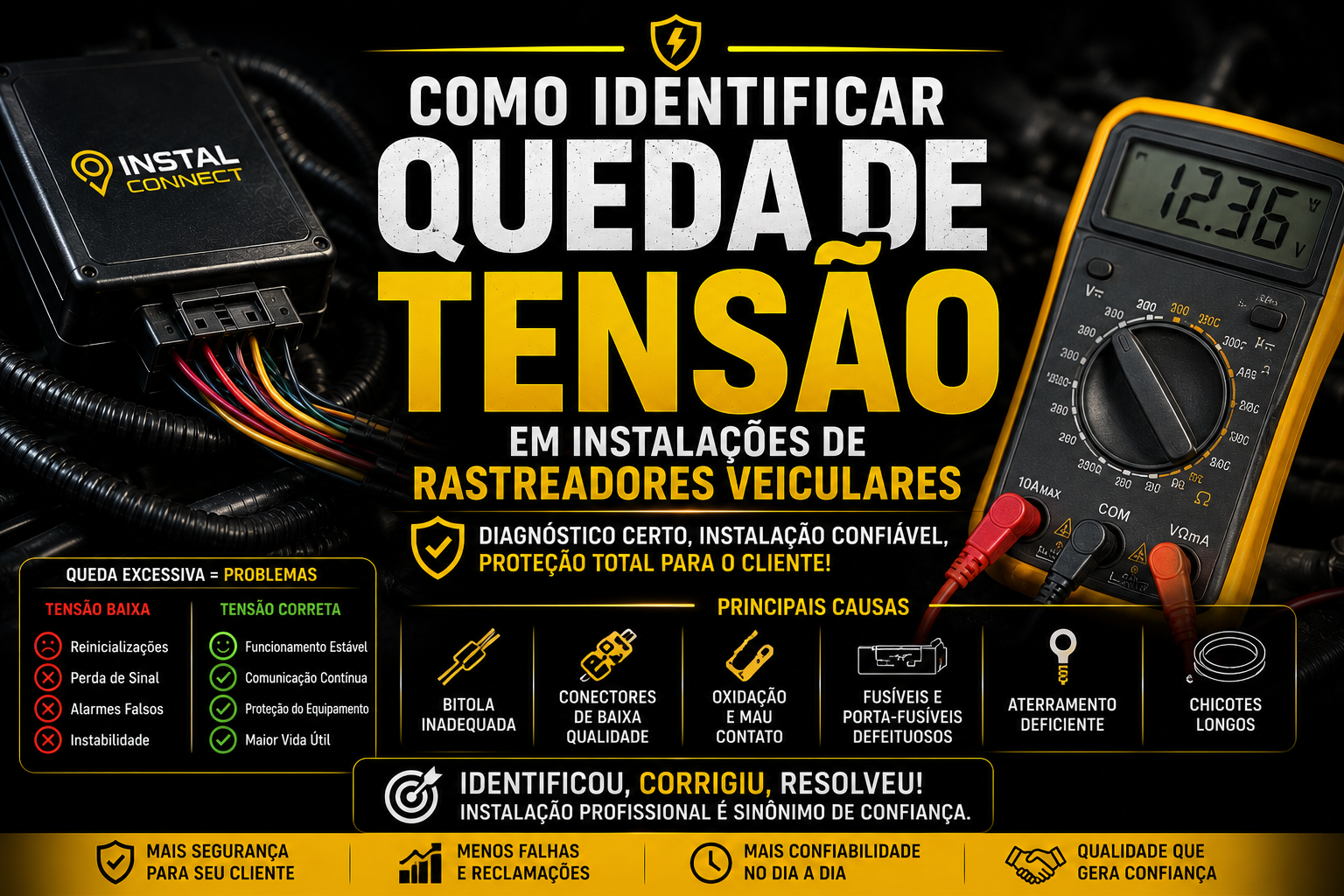
Among the most common are: inadequate wire gauge; very long harnesses; low-quality connectors; poorly executed splices; terminal oxidation; deficient grounding; fuse holders with poor contact; natural wear of components.
In most cases, the problem is not in a single point, but in the sum of small losses along the circuit.
Most common symptoms
An elevated voltage drop can cause various seemingly unrelated symptoms.
The most frequent are: tracker restarting by itself; temporary loss of communication; intermittent location; blockage not responding correctly; failures during vehicle startup; momentary power loss; unexpected alarms.
Many of these occurrences are attributed to the equipment when, in reality, they originate from the electrical installation.
The role of wire gauge
Choosing the correct wire gauge is one of the most important factors for reducing electrical losses.
Undersized conductors have higher resistance, naturally increasing voltage drop.
Therefore, dimensioning must consider: current; harness length; installation environment; conductor type.
This topic was explored in depth in the article How to Choose the Correct Wire Gauge in Vehicle Tracker Installations.
Connectors also influence
Each electrical connection adds a small resistance to the circuit.
When connectors exhibit: play; oxidation; low quality; improper assembly,
this resistance increases significantly.
Over time, this can cause overheating and loss of performance.
The importance of grounding
Grounding is often neglected.
However, an inadequate grounding point can cause symptoms identical to those caused by voltage drop.
Painted, oxidized, or poorly fixed surfaces increase electrical resistance and compromise the equipment's power supply.
Fuses and fuse holders
Another frequently overlooked point is the assembly consisting of the fuse and fuse holder.
When they show wear, oxidation, or low manufacturing quality, they become an additional source of electrical resistance.
Although they seem like simple components, they can significantly influence the circuit's performance.
The influence of engine start
During startup, especially in diesel engines and heavy vehicles, there is a high demand for electrical current.
At this moment, a temporary reduction in available voltage is common.
A correctly designed installation must consider this behavior to ensure stability throughout the vehicle's operating cycle.
Trucks require special attention
In trucks, buses, and heavy machinery, harnesses usually cover much greater distances than in cars.
The longer the conductors, the greater the total resistance of the circuit tends to be.
Therefore, projects in 24V systems require double attention regarding cable dimensioning and component quality.
How to prevent problems
Best practices include: using good quality copper wires; selecting the appropriate gauge; using certified automotive connectors; properly protecting the harness; avoiding unnecessary splices; keeping grounds clean and firm; using reliable fuse holders; performing preventive inspections.
Small precautions during installation prevent a large part of future occurrences.
Benefits of a well-dimensioned installation
A correctly designed installation provides: stable electrical power; higher reliability; lower maintenance rates; longer equipment lifespan; reduction of warranty costs; better customer experience.
These benefits make the investment in quality materials highly worthwhile.
Conclusion
Voltage drop is one of the main causes of failures in vehicle tracking systems and, at the same time, one of the least perceived during initial diagnosis.
In most situations, the problem is related to the entire installation: quality of wires, connectors, fuses, grounding, and harness organization.
By adopting good installation practices and correctly selecting components, the technician significantly reduces the possibility of failures, increases system durability, and delivers a much more reliable service to the client.
Frequently Asked Questions (FAQ) What is voltage drop?
It is the reduction of electrical voltage along a circuit due to the natural resistance of conductors and connections.
Can voltage drop shut down a tracker?
Yes. If the available voltage drops below the equipment's operating range, reboots, loss of communication, or unstable operation may occur.
Does grounding influence it?
Very much so. Inadequate grounding increases the electrical resistance of the circuit and can cause symptoms similar to those of a voltage drop.
Does wire gauge interfere?
Yes. Undersized conductors have higher electrical resistance and promote voltage losses.
How to reduce voltage drop?
By using good quality copper wires, appropriate gauge, certified connectors, reliable fuse holders, correct grounding, and an organized installation.
Related articles
 Tracking Equipment
What is APN and How to Properly Configure a Vehicle Tracker
Learn what APN is, how it works, and how to properly configure a vehicle tracker to ensure communication with the monitoring platform and avoid transmission failures.
 Tracking Equipment
How GSM Communication Works in Vehicle Trackers: Understanding How Data Reaches the Platform
Discover how GSM communication works in vehicle trackers and understand how location information is transmitted from the vehicle to the monitoring platform using mobile networks.
 Tracking Equipment
GPS vs GNSS: What's the Difference and Why Do Modern Trackers Use Multiple Satellite Systems?
Understand the difference between GPS and GNSS and discover why modern trackers use multiple global navigation satellite systems for greater accuracy, availability, and reliability.