
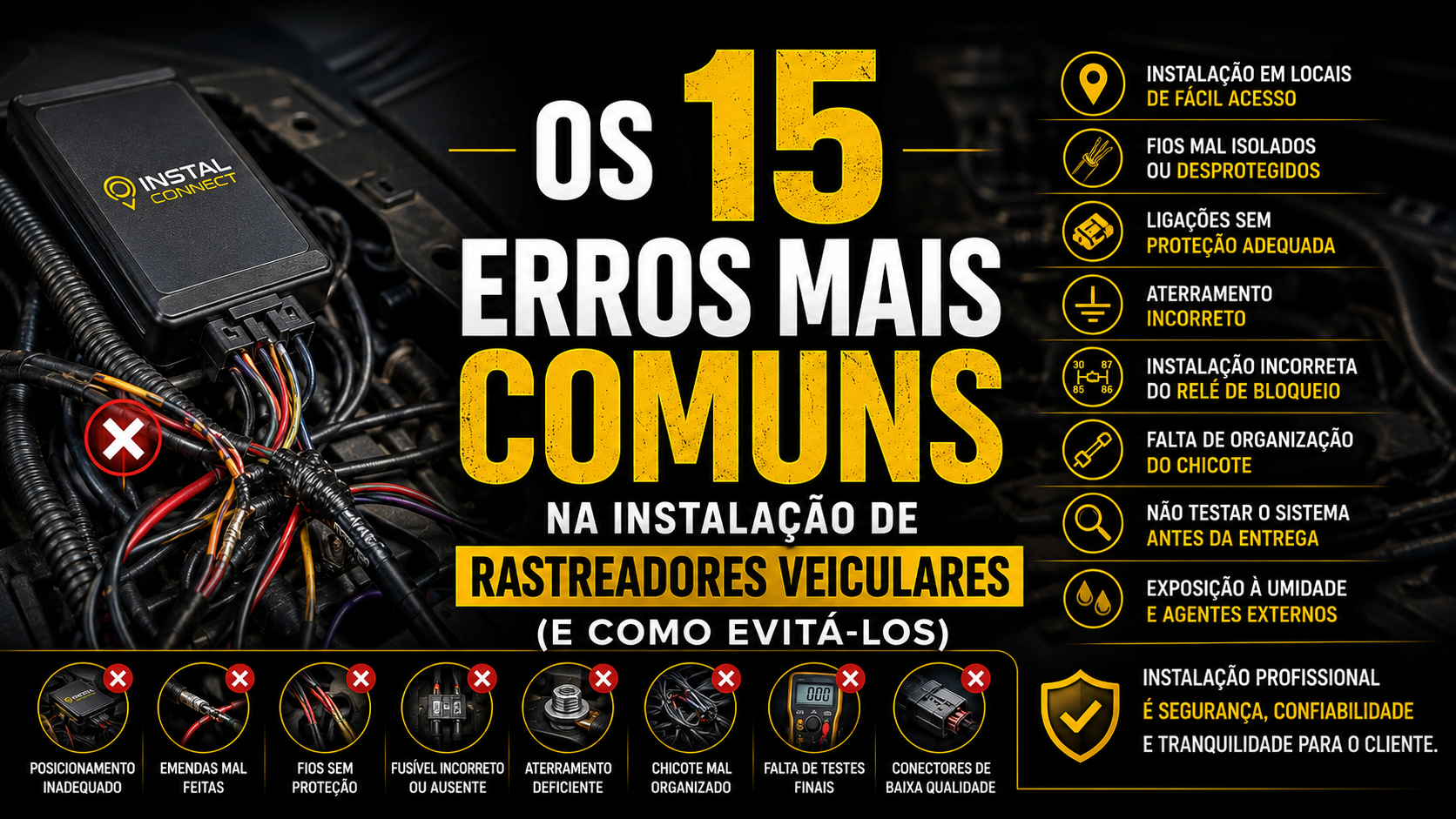
The 15 Most Common Mistakes in Vehicle Tracker Installation (and How to Avoid Them)
Learn about the 15 most common mistakes found in vehicle tracker installations and discover how to avoid them to ensure greater security, reliability, and durability of the system.
Always consult updated electrical diagrams and confirm each circuit with measuring equipment.
- Choosing Inadequate Grounding
Grounding directly influences the tracker's operation.
Points with paint, rust, or poor contact cause reboots and communication failures.
How to avoid
Use only clean, firm metal points with excellent electrical continuity.
- Using Low-Quality Wires
Saving money on the harness often proves costly.
Low-quality wires have higher electrical resistance and lower durability.
How to avoid
Opt for good quality copper wires with compatible gauge and adequate insulation for automotive applications.
- Not Using a Fuse
Some installations are still carried out without electrical protection.
This significantly increases risks in case of a short circuit.
How to avoid
Always install a correctly sized fuse positioned close to the power supply point.
- Choosing an Inadequate Relay
Low-quality or undersized relays can fail after a short period of use.
How to avoid
Use certified automotive relays compatible with the circuit's voltage and current.
- Performing Poorly Executed Splices
Improvised connections are among the main causes of maintenance.
How to avoid
Make firm connections using appropriate materials and quality insulation.
- Incorrectly Positioning the GPS Antenna
Even excellent quality equipment can exhibit low precision when the antenna is installed in an inappropriate location.
How to avoid
Follow the manufacturer's recommendations for positioning and avoid locations with strong structural interference.
- Installing Components Near Heat Sources
High temperatures reduce the lifespan of electronic equipment and the harnesses themselves.
How to avoid
Choose well-ventilated locations far from components that reach high temperatures.
- Not Protecting the Harness
Exposed cables can suffer friction, vibration, and premature wear.
How to avoid
Use conduits, corrugated sleeves, and proper fastening to protect the entire installation.
- Not Organizing Cables
Beyond visual appearance, disorganized harnesses complicate future maintenance.
How to avoid
Bundle cables, use zip ties, and maintain a clean and secure routing.
- Not Updating Firmware
Some equipment continues to function for years with old firmware versions.
How to avoid
Always check for available updates before vehicle delivery.
- Not Testing Immobilization
Trusting only the installation without validating system operation can lead to future problems.
How to avoid
Perform full activation and deactivation tests according to the manufacturer's recommendations.
- Ignoring Communication Test
The tracker might be correctly powered but not transmitting data to the platform.
How to avoid
Confirm position sending, real-time updates, and command reception before delivery.
- Not Documenting the Installation
Lack of documentation makes future technical interventions difficult.
How to avoid
Record IMEI, ICCID, serial number, installation photos, and test results.
- Delivering the Vehicle Without a Final Inspection
This is perhaps the most common mistake.
Haste in delivery causes small details to go unnoticed.
How to avoid
Before delivery, check:
- interior finishes;
- vehicle operation;
- communication;
- GPS;
- immobilization;
- harness;
- alerts;
- installation cleanliness.
A final review significantly reduces the return rate.
What Differentiates a Professional Installer?
Technical knowledge is important, but not sufficient.
The best professionals work with standardized processes, quality materials, and a rigorous testing routine.
They understand that the company's reputation depends on the reliability of every installation performed.
Benefits of Avoiding These Mistakes
A well-executed installation provides:
- lower maintenance rates;
- reduced warranty costs;
- longer equipment lifespan;
- greater electrical safety;
- higher customer satisfaction;
- better company image.
Furthermore, standardized processes increase team productivity and reduce rework.
Conclusion
The errors presented in this article are responsible for a large portion of failures found in vehicle tracking systems.
Although many seem like small details, each installation step directly influences the security, reliability, and durability of the system.
Investing in quality materials, following standardized procedures, and performing complete tests before delivery are actions that differentiate a common service from a truly professional installation.
In an increasingly competitive market, avoiding these mistakes means reducing costs, strengthening the company's reputation, and offering the customer a reliable system for many years.
Quick Checklist Before Delivery
Before finalizing any installation, confirm:
✅ Permanent power supply
✅ Post-ignition power supply
✅ Grounding
✅ Fuse
✅ Relay
✅ Protected harness
✅ GPS antenna
✅ GSM communication
✅ Firmware updated
✅ Platform communicating
✅ Immobilization tested
✅ Vehicle tested
✅ Finish reviewed
✅ Photos recorded
✅ Client oriented
Frequently Asked Questions (FAQ)
What is the most common mistake in tracker installations?
The absence of complete tests before delivery and poorly executed electrical connections are among the most frequent issues.
Is it worth using higher quality components?
Yes. Relays, wires, connectors, and fuses from reputable sources significantly reduce the need for maintenance.
Does grounding really influence operation?
Yes. Inadequate grounding can cause communication loss, reboots, and intermittent failures.
Why document the installation?
Documentation facilitates future maintenance, reduces diagnostic time, and improves the company's quality control.
How to reduce the warranty rate?
By following a standardized checklist, using quality materials, and performing complete tests before delivery.
Related articles
 Tracker Installation
How to Install a Tracker on a Motorcycle Without Voiding the Warranty? Technical Guide with Plug-and-Play Connectors
Learn how to install motorcycle trackers using plug-and-play connectors, preserving the original harness, reducing electrical interventions, and making installation safer, more professional, and reversible.
 Tracker Installation
How to Install a Vehicle Tracker While Preserving the Original Wiring Harness and Vehicle Warranty: A Comprehensive Technical Guide
Learn the best practices for installing a vehicle tracker while preserving the original wiring harness and reducing the risk of electrical problems. Discover professional techniques, tools, connectors, and precautions that help maintain vehicle integrity.
 Tracker Installation
Does Installing a Vehicle Tracker Void the Factory Warranty? A Complete Guide for Owners, Businesses, and Installers
Discover if installing a vehicle tracker can void your factory warranty. Understand how warranties work, precautions to take during installation, consumer rights, and best practices to preserve vehicle integrity.