
Does Installing a Vehicle Tracker Void the Factory Warranty? A Complete Guide for Owners, Businesses, and Installers
Discover if installing a vehicle tracker can void your factory warranty. Understand how warranties work, precautions to take during installation, consumer rights, and best practices to preserve vehicle integrity.
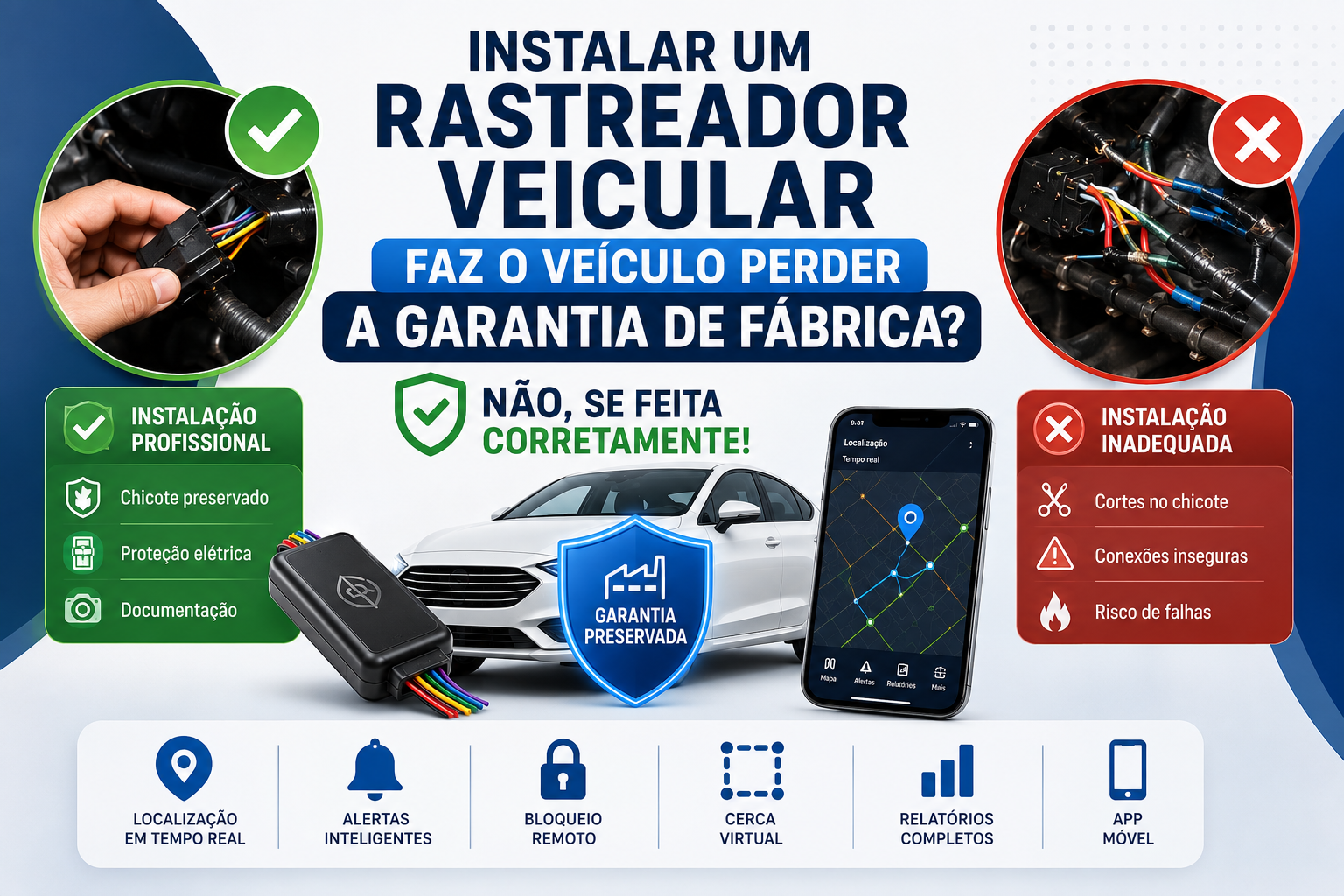
Does Installing a Vehicle Tracker Void the Factory Warranty? A Complete Guide for Owners, Businesses, and Installers
One of the most common questions among new car owners is:
"If I install a vehicle tracker, will I lose my factory warranty?"
This concern is completely understandable. After all, a new vehicle represents a significant investment, and no one wants to risk losing the coverage offered by the manufacturer.
The good news is that, in most situations, the simple installation of a tracker does not automatically void the vehicle's warranty. However, there are important precautions that need to be observed to avoid future problems.
In this complete guide, you will understand how factory warranties work, what situations can lead to questions, what are the installer's responsibilities, and what best practices help preserve the vehicle's integrity.
How does a factory warranty work?
A factory warranty is a commitment made by the manufacturer to repair manufacturing defects during a specified period or mileage.
It typically covers components that fail due to design, manufacturing, or assembly problems.
However, the warranty does not cover damage caused by:
accidents; improper use; improper modifications; incorrect maintenance; poorly executed technical interventions.
It is precisely at this point that questions related to accessory installation arise.
Does installing a tracker void the vehicle's warranty?
In the vast majority of cases, no.
The installation of a tracker, by itself, does not mean that the entire vehicle warranty will be canceled.
The central point is different:
If a problem occurs and it is proven that it was caused by the tracker installation, coverage for that specific component may be refused.
This is very different from stating that the entire vehicle loses its warranty.
What can actually happen?
Consider a few scenarios.
Scenario 1
The tracker was installed correctly.
Six months later, the air conditioning compressor develops a manufacturing defect.
There is no relation between the two facts.
In this case, there is usually no reason to deny coverage for that component.
Scenario 2
During installation, inadequate cuts were made in the original wiring harness.
Some months later, electrical failures appear exactly in that circuit.
If it is demonstrated that the intervention caused the problem, coverage for that repair may be refused.
Scenario 3
The tracker was installed using appropriate connectors, wiring harness protection, and following technical procedures.
Later, a defect occurs in the suspension system.
Again, there is no technical relationship between the facts.
The installer's role
A large part of warranty preservation depends on the quality of the installation.
A qualified professional should:
study the electrical diagram; correctly identify power and ignition switch; use appropriate fuses; avoid improvisations; protect the wiring harness; document the entire installation.
These precautions significantly reduce any risk.
Should the original wiring harness be cut?
Whenever possible, no.
Today, there are various solutions that reduce the need for permanent alterations to the electrical system.
Best practices include:
using specific connectors; adapter harnesses when available; quality automotive terminals; protecting connections with heat shrink tubing.
The less intervention in the original wiring, the better.
The importance of documentation
Professional companies document every installation.
This documentation may include:
photos of the service; identification of the points used; equipment model; serial number; installation date; technical report.
In addition to facilitating future maintenance, these records demonstrate that the installation was performed according to technical criteria.
What do manufacturers' manuals say?
Each manufacturer has specific guidelines for accessory installation.
Some vehicles offer power points intended for additional equipment.
Others recommend specific procedures for interventions in the electrical system.
Therefore, always consult the owner's manual and, when available, the manufacturer's technical documentation before performing the installation.
Hybrid and electric vehicles require special attention
Electrified vehicles have a more sophisticated electrical architecture than conventional vehicles.
Although many trackers are powered by the 12V auxiliary battery, it is crucial to avoid any intervention in high-voltage systems.
Additionally:
strictly follow the vehicle manufacturer's guidelines; use compatible equipment; preserve the originality of the wiring harness; only have the installation performed by qualified professionals.
What about fleet vehicles?
Companies that manage fleets typically install trackers immediately after acquiring vehicles.
To preserve the reliability of installations, it is recommended to:
standardize procedures; use approved equipment; maintain complete documentation; record all interventions performed.
This history facilitates audits and future maintenance.
How to choose an installation company?
Before hiring a service, check for:
experience in the segment; technical training of the team; installation warranty; use of quality automotive components; organization of the wiring harness; documentation provided to the customer; after-sales support.
A well-executed installation significantly reduces the risk of future problems.
Errors that can compromise the installation
Among the most common errors are:
unnecessary cuts in the original wiring harness; improvised connections; absence of protective fuse; inadequate grounding; use of low-quality connectors; installation near heat sources; lack of documentation.
Checklist before installing a tracker
Before installation, confirm:
✔ The equipment is compatible with the vehicle.
✔ The installer has experience.
✔ Quality automotive components will be used.
✔ The wiring harness will be protected.
✔ The installation will be documented.
✔ Tests will be performed before delivery.
✔ The customer will receive instructions on equipment operation.
✔ The company offers a warranty on the executed service.
Myths and Truths
"Any tracker voids the vehicle's warranty."
❌ Myth.
What may occur is the refusal of coverage for a component whose failure is demonstrably due to improper installation.
"A professional installation reduces risks."
✅ Truth.
Following best practices and using quality components helps preserve the integrity of the electrical system.
"Hybrid vehicles require additional care."
✅ Truth.
These vehicles have a more complex electronic architecture and require specific procedures.
"Keeping photos and documentation of the installation is important."
✅ Truth.
These records facilitate future maintenance and demonstrate the quality of the executed service.
Benefits of professional installation
When installation is performed correctly, the benefits include:
preservation of electrical integrity; reduction of failures; ease of maintenance; increased system reliability; lower risk of rework; more security for the owner.
Conclusion
Installing a vehicle tracker does not, by itself, void the factory warranty. The determining factor is the quality of the installation and the relationship between a potential failure and the intervention performed on the vehicle.
By choosing appropriate equipment, relying on qualified professionals, and following the recommendations of the vehicle and tracker manufacturers, it is possible to enjoy the benefits of monitoring without compromising the reliability of the electrical system.
More than installing equipment, the objective should be to preserve the originality of the vehicle, document the entire process, and adopt good technical practices. This way, owners, businesses, and installers reduce risks and increase safety throughout the vehicle's lifespan.
Frequently Asked Questions (FAQ)
Does installing a tracker void the entire vehicle warranty?
No. Installation, by itself, does not imply automatic loss of warranty. If a problem arises, it will be analyzed whether there is a technical relationship between the failure and the intervention performed.
Can I install a tracker in a brand-new car?
Yes. Provided that the installation is done correctly, using appropriate components and respecting the guidelines of the vehicle and tracker manufacturers.
Can hybrid and electric vehicles receive trackers?
Yes. However, they require additional care due to their more complex electrical architecture. Installation must be performed by qualified professionals.
Should the installation company provide documentation?
It is highly recommended. Photos, a technical report, and identification of connection points facilitate future maintenance and demonstrate the quality of the installation.
How to reduce the risk of problems?
Choose quality equipment, use a specialized company, and avoid unnecessary interventions in the vehicle's original electrical system.
Related articles
 Tracker Installation
How to Install a Tracker on a Motorcycle Without Voiding the Warranty? Technical Guide with Plug-and-Play Connectors
Learn how to install motorcycle trackers using plug-and-play connectors, preserving the original harness, reducing electrical interventions, and making installation safer, more professional, and reversible.
 Tracker Installation
How to Install a Vehicle Tracker While Preserving the Original Wiring Harness and Vehicle Warranty: A Comprehensive Technical Guide
Learn the best practices for installing a vehicle tracker while preserving the original wiring harness and reducing the risk of electrical problems. Discover professional techniques, tools, connectors, and precautions that help maintain vehicle integrity.
 Tracker Installation
How to Diagnose Vehicle Tracker Failures: A Complete Guide for Installers
Learn how to diagnose the main failures in vehicle trackers. Discover a complete step-by-step guide to identify problems with power, GPS, GSM, wiring harness, antennas, relays, blocking, and platform communication.