
How to Prevent Excessive Battery Drain in Vehicle Trackers: Main Causes and Solutions
Understand why some trackers can contribute to vehicle battery drain and discover the main causes, best installation practices, and solutions to avoid electrical problems and extend battery life.
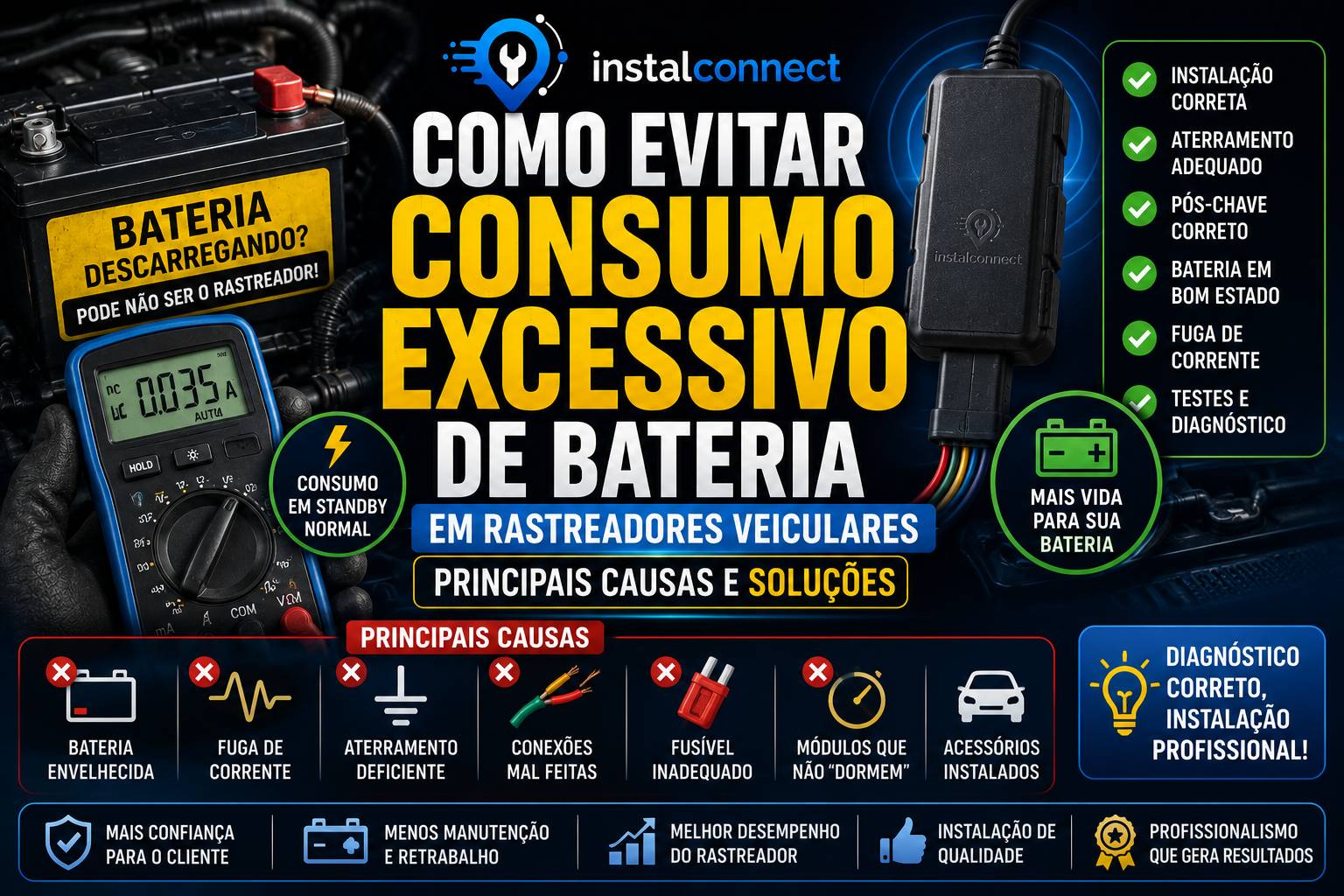
One of the most frequent questions among customers and installers is: "Does the tracker drain the vehicle battery?"
In most cases, the answer is no, as long as the equipment is suitable, working correctly, and installed following the manufacturer's recommendations.
However, improper installation, battery problems, parasitic draw, or failures in other electrical components can lead to premature battery discharge, causing the tracker to be blamed, even when it is not the root cause of the problem.
In this article, you will understand how electrical consumption occurs in trackers, what factors truly influence battery autonomy, and what precautions help prevent this type of occurrence.
Do all trackers consume energy?
Yes.
Every electronic device connected to the vehicle consumes energy, even when the car is turned off.
The tracker needs to remain powered to:
- Maintain communication with the platform;
- Receive commands;
- Log events;
- Transmit location when necessary;
- Monitor sensors.
This consumption, however, is typically designed to be compatible with the vehicle's electrical system.
When does consumption become a problem?
The problem is usually not related solely to the tracker.
Several factors can contribute to battery discharge.
Among them:
- Aging battery;
- Low-efficiency alternator;
- Current leakage;
- Improperly installed accessories;
- Electronic modules that remain active;
- Improvised electrical installations.
The diagnosis must consider the entire electrical system.
What is standby consumption?
Even when turned off, a modern vehicle continues to power various electronic modules.
Alarms, electronic control units, clock, radio memory, and the tracker itself continue to consume small amounts of energy.
This behavior is normal.
The important thing is that the total consumption remains within the limits specified by the vehicle manufacturer.
The importance of professional installation
A large part of the problems attributed to the tracker is related to the quality of the installation.
A professional installation should ensure:
- Correct power supply;
- Efficient grounding;
- Quality connections;
- Wiring harness protection;
- Circuit identification;
- Tests after installation.
These precautions significantly reduce the risk of failures.
Attention to the ignition switch (key-on)
The ignition switch plays an important role in consumption management.
When correctly identified, it allows the tracker to recognize the vehicle's states and operate according to its programming.
An incorrect connection can cause unexpected behavior and make consumption diagnosis difficult.
Check the battery status
Before attributing the problem to the tracker, check the battery itself.
Old or reduced-capacity batteries may have difficulty holding a charge, especially when the vehicle remains unused for several days.
A preventive inspection prevents incorrect diagnoses.
Take measurements with appropriate instruments
Diagnosis should be performed using appropriate equipment, such as:
- Multimeter;
- DC clamp meter;
- Automotive analyzers.
These tools allow identifying abnormal consumption and locating possible current leaks.
Modern vehicles behave differently
In many modern vehicles, various modules remain active for a few minutes after the ignition is turned off.
Therefore, consumption should only be measured after the vehicle enters sleep mode.
Ignoring this detail can lead to mistaken interpretations.
Electric and hybrid vehicles
These vehicles usually have an auxiliary 12V battery responsible for powering the electronic modules.
Although the principle is similar to conventional vehicles, the behavior of the systems may vary by manufacturer.
Always consult the technical documentation before performing any diagnosis.
Installation organization makes a difference
In addition to the correct power supply, good organization of the wiring harness facilitates future inspections.
Maintain:
- Conduits;
- Cable ties;
- Cable identification;
- Installation documentation.
These details accelerate diagnosis when needed.
Most common errors
Among the problems found are:
- Power supply connected to an inadequate circuit;
- Deficient grounding;
- Deteriorated battery;
- Poorly executed connections;
- Current leakage in accessories;
- Absence of tests;
- Diagnosis based only on assumptions.
Checklist to avoid excessive consumption
Before completing the installation, confirm:
✔ Correct power supply.
✔ Ignition switch identified.
✔ Grounding tested.
✔ Protected connections.
✔ Organized wiring harness.
✔ Battery in good condition.
✔ Consumption measured after the vehicle enters sleep mode.
✔ Installation documented.
Benefits of a well-executed installation
When all procedures are followed correctly, the benefits include:
- Longer battery life;
- Reduced maintenance returns;
- Greater tracker reliability;
- Lower incidence of incorrect diagnoses;
- Customer satisfaction;
- Preservation of the vehicle's original electrical system.
Conclusion
The vehicle tracker is part of the vehicle's electrical consumers, but it is rarely solely responsible for battery drain problems. In most situations, the cause is related to a combination of a worn battery, inadequate installations, current leakage, or malfunctioning components.
Professional installation, combined with accurate measurements and a comprehensive diagnosis of the electrical system, is the best way to avoid problems and ensure that the tracker operates efficiently and safely throughout the vehicle's lifespan.
Frequently Asked Questions (FAQ)
Does the tracker drain the vehicle battery?
Not necessarily. The equipment has continuous consumption, but usually within the limits set for the vehicle's electrical system.
How to know if there is current leakage?
Measurements must be taken with appropriate instruments, preferably after the vehicle enters sleep mode.
Can an old battery cause problems even if the tracker is installed correctly?
Yes. Reduced battery capacity can cause starting difficulties and be mistaken for excessive tracker consumption.
Does the ignition switch affect consumption?
Yes. An incorrect connection can alter the equipment's behavior and complicate diagnosis.
Do electric vehicles also have a 12V battery?
In most cases, yes. It powers the electronic modules and usually also provides energy to the tracker.
Related articles
 Tracker Installation
How to Install a Tracker on a Motorcycle Without Voiding the Warranty? Technical Guide with Plug-and-Play Connectors
Learn how to install motorcycle trackers using plug-and-play connectors, preserving the original harness, reducing electrical interventions, and making installation safer, more professional, and reversible.
 Tracker Installation
How to Install a Vehicle Tracker While Preserving the Original Wiring Harness and Vehicle Warranty: A Comprehensive Technical Guide
Learn the best practices for installing a vehicle tracker while preserving the original wiring harness and reducing the risk of electrical problems. Discover professional techniques, tools, connectors, and precautions that help maintain vehicle integrity.
 Tracker Installation
Does Installing a Vehicle Tracker Void the Factory Warranty? A Complete Guide for Owners, Businesses, and Installers
Discover if installing a vehicle tracker can void your factory warranty. Understand how warranties work, precautions to take during installation, consumer rights, and best practices to preserve vehicle integrity.