
Solder or Connector? Which is the Best Choice for Vehicle Tracker Installation?
When installing vehicle trackers, one of the biggest questions is: solder or connectors? Learn about the advantages, limitations, and best practices of each method to ensure safety, reliability, and durability.
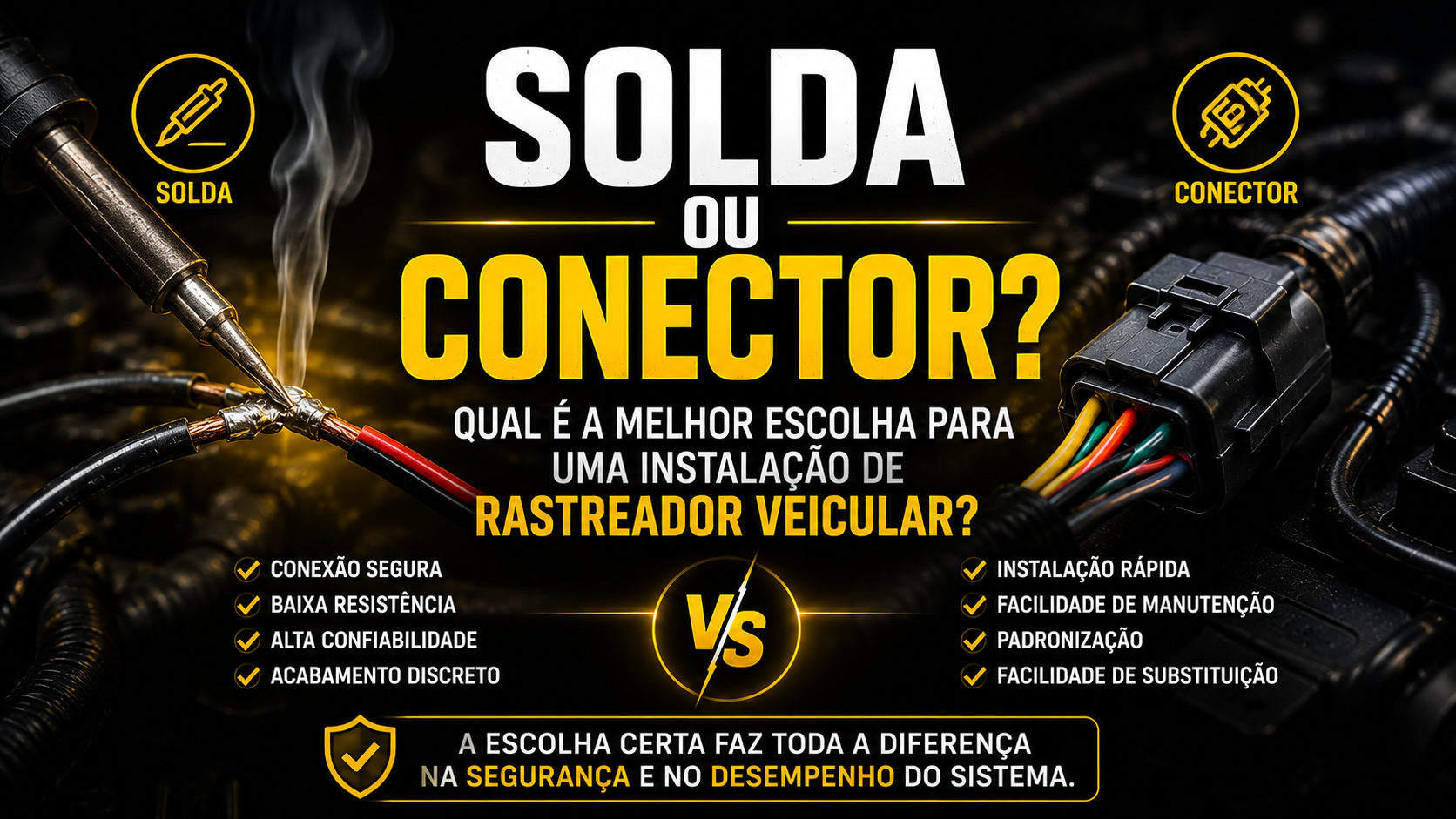
Few topics generate as much discussion among tracking technicians as the choice between solder and electrical connectors. While some professionals argue that only soldering guarantees a reliable connection, others assert that quality automotive connectors offer excellent performance and facilitate future maintenance.
The truth is that both methods can provide great results when applied correctly. What truly determines the quality of an installation is the combination of appropriate materials, execution technique, and respect for the vehicle's characteristics.
In this article, you will understand the differences between solder and connectors, learn about their advantages and limitations, and discover which best practices should guide a professional installation.
The importance of electrical connections
Regardless of the chosen method, every installation depends on reliable electrical connections.
A poorly executed connection can lead to:
- power loss;
- intermittent failures;
- overheating;
- oxidation;
- increased electrical resistance;
- diagnostic difficulties;
- reduced component lifespan.
Therefore, connections deserve the same attention given to the tracker, relay, and automotive harness.
What is a soldered connection?
Soldering involves joining conductors using an appropriate metal alloy, typically tin-based for electronic applications.
When done correctly, soldering creates a continuous electrical contact between wires.
Its main benefits include:
- low electrical resistance;
- excellent electrical continuity;
- good durability;
- compact finish.
However, the quality directly depends on the technique used.
Advantages of soldering
A well-executed soldered connection offers several advantages:
- efficient electrical contact;
- lower risk of poor contact;
- good stability over time;
- discreet finish.
Furthermore, when protected with adequate insulation, it performs excellently in automotive installations.
Care in using solder
Despite its advantages, soldering requires attention.
Key considerations include:
- using appropriate materials;
- avoiding excessive conductor heating;
- protecting the soldered area with adequate insulation;
- ensuring mechanical strain relief.
A poorly executed solder can be as problematic as a poorly fitted connection.
What are automotive connectors?
Automotive connectors are components designed to safely join wires and facilitate future technical interventions.
There are various models, designed for different applications, currents, and operating environments.
When correctly specified and installed, they offer high reliability.
Advantages of connectors
Benefits of automotive connectors include:
- speed of installation;
- ease of maintenance;
- standardization;
- reduced component replacement time;
- possibility of disassembly without cutting wires.
These characteristics are especially useful in installations that may require future inspections.
Not all connectors offer the same performance
It is important to note that there are significant quality differences among connectors available on the market.
Automotive connectors developed for professional applications feature:
- corrosion-resistant materials;
- high-quality metallic contacts;
- good mechanical locking;
- vibration protection.
Low-quality products, on the other hand, may exhibit looseness, premature oxidation, and loss of electrical contact.
Vibration is an important factor
The automotive environment subjects the entire installation to constant vibrations.
Therefore, both soldered connections and connectors need to be installed in a way that they are not subjected to repetitive mechanical stress.
Proper fastening and harness organization are crucial for increasing installation durability.
Protection against moisture
Regardless of the chosen method, protection against moisture must be considered.
In areas subject to condensation or indirect water exposure, it is recommended to use materials appropriate for the automotive environment and ensure efficient insulation of connections.
Ease of maintenance
Another important aspect is future maintenance.
In certain applications, connectors facilitate inspections, replacements, and diagnostics, reducing intervention time.
On the other hand, soldered connections can offer excellent reliability when frequent disassembly is not necessary.
What to observe when choosing?
Before defining the connection method, consider:
- circuit type;
- electrical current;
- installation environment;
- need for future maintenance;
- quality of materials used;
- equipment manufacturer's recommendations.
There is no universal solution. Each application must be analyzed individually.
Best practices for any method
Regardless of the chosen option, a professional installation must follow some principles:
- use quality materials;
- correctly size the conductors;
- protect the connections;
- organize the harness;
- avoid mechanical stress on the wires;
- perform electrical tests before vehicle delivery.
These precautions have a much greater impact on system reliability than the simple choice between solder or connector.
The discussion between solder and connectors should not be treated as a dispute between methods. Both can offer excellent performance when used correctly and with appropriate materials.
The true differential of a professional installation lies in the installer's technical knowledge, the choice of quality components, and the careful execution of each step of the service.
More important than choosing between solder or a connector is ensuring secure, well-protected connections capable of withstanding the harsh conditions of the automotive environment for many years.
Frequently Asked Questions (FAQ) Is solder always better than a connector?
No. Both can perform excellently when properly applied and using quality materials.
Can I use any automotive connector?
No. The connector must be compatible with the electrical current, installation environment, and intended application.
Can vibration affect connections?
Yes. Therefore, it is essential to organize the harness, secure the cables correctly, and avoid mechanical stress on the connections.
Is connection insulation important?
Very. Adequate insulation helps protect against moisture, dust, and other agents that can compromise the durability of the installation.
What truly defines a good installation?
The combination of technical knowledge, quality materials, harness organization, reliable connections, and complete tests before vehicle delivery.
Related articles
 Tracker Installation
How to Install a Tracker on a Motorcycle Without Voiding the Warranty? Technical Guide with Plug-and-Play Connectors
Learn how to install motorcycle trackers using plug-and-play connectors, preserving the original harness, reducing electrical interventions, and making installation safer, more professional, and reversible.
 Tracker Installation
How to Install a Vehicle Tracker While Preserving the Original Wiring Harness and Vehicle Warranty: A Comprehensive Technical Guide
Learn the best practices for installing a vehicle tracker while preserving the original wiring harness and reducing the risk of electrical problems. Discover professional techniques, tools, connectors, and precautions that help maintain vehicle integrity.
 Tracker Installation
Does Installing a Vehicle Tracker Void the Factory Warranty? A Complete Guide for Owners, Businesses, and Installers
Discover if installing a vehicle tracker can void your factory warranty. Understand how warranties work, precautions to take during installation, consumer rights, and best practices to preserve vehicle integrity.